Home › Forums › Talk Hockey › Daily Drill Part Seven
- This topic has 67 replies, 2 voices, and was last updated 15 years, 3 months ago by
Tom Molloy.
-
AuthorPosts
-
April 7, 2011 at 3:03 pm #3855
Tom Molloy
KeymasterT2 – B6 D to D Hinge and Switch – Pro W
Key Points:
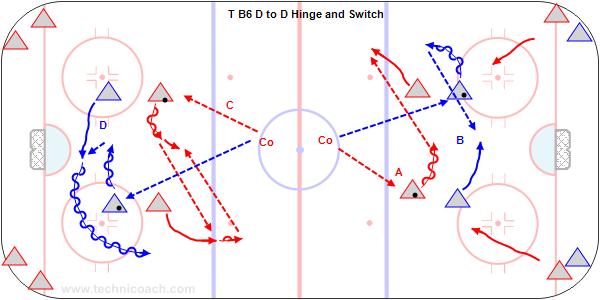
Pass back to the coach after each one of these sequences. Coach should pass to one player and after the sequence get a return pass then pass to the other player. This is a controlled breakout after a regroup or any situation with only one forechecker.Description:
1. Coach in the neutral zone pass to a player coming from the corners.
A. Player skates to mid ice and passes to partner who hinges wide and up ice.
B. Player skates to wide lane and pass to partner who supports in mid ice behind.
C. Player skate to middle, pass wide, get return pass in middle.
D. Player skate to middle, partner skate behind for a pass and switch sides. From there any of the other options.
*Pass back to the coach after each of these exercises and then add players who regroup with D.https://www.hockeycoachingabcs.com/videos/watch/t2-b6-d-to-d-hinge-and-switch-pro-w/

Attachments
'The Game is the Greatest Coach'
'Enjoy the Game'April 8, 2011 at 2:48 pm #3861KeymasterT2 – Take the Ice Behind to Create 2-1's -Sweden-Soviets-Pro
When Ice Hockey originated in North America in the late 1800's forward passes were not allowed. The game was played with 6 skaters and a goalie. Later the Rover position was eliminated and teams played with 5 skaters. We developed playing lane hockey with the D staying back, the wings in their lanes and only the centre going side to side. The game now is developing towards "Total Hockey" where players have a Home Position at the Face off and after that it is 1-2-3-4-5 according to the system you are playing, the zone you are in and the closeness to the puck. So we have to teach all players all the offensive and defensive skills in practice.
In other parts of the world the game came later. Bandy is played in Russia and Scandanavia on a frozen soccer field and has a big influence in those areas. German, Czech Republic, Austria have a huge soccer football history and in soccer and bandy they build the attack with lots of give and goes and regroups.
In North America the CONVENTIONAL WISDOM is that you go in straight lines and move the puck up as quickly as possible to trap the other team. This works vs an aggressive PRESSURE forecheck and can create outnumber situations. If you are playing against a CONTAIN forecheck where the send either one or zero players in then you will not beat them to the net with straight ahead speed but have to use CHANGE OF SPEED, CHANGE OF LANES, and create situations where the defenders must make DECISIONS such as whether to switch on a cross or stay with their man.
The attackers must continually go to the "Big Ice" between the dots where more attack options are possible. Create 2 on 1's continuously and regroup to force the defenders to keep a tight gap or to hit a late attacker who is skating fast vs the defenders holding the blue line.
I have put some video from Swedish and the Czech pro teams to demonstrate these offensive options.
Key Points:
When the defenders are using a contain forecheck and are ahead of the puck you cannot beat them skating in straight lines. You must continually isolate the wide player and create 2 on 1 situations. Support by taking the ice behind the puck carrier.Description:
1. Practice with a 2 on 2 situation and isolate a defender by crossing.
a. Cross drop and #1 screen weak side D.
b. Cross, drop 1 to net, 2 wide.
c. Cross and fake drop. 1 through middle 2 go to the net.
Create 3 on 3 situations in drills and games.
d. #’s 2 and 3 go hard to the net.
e. #1 go to the middle and shoot or pass.* Other options are another cross behind or pass back to the 4th and 5th supporting attackers.
Important is to change the speed and angle of the attack and force defensive decisions like switch or stay man to man.
https://www.hockeycoachingabcs.com/videos/watch/t2-support-by-taking-the-ice-behind/

T2 – Soviets – Take Ice Behind Support – Soviets

T2 – B6 – 2-0-Gain Zone-X and Drop – Pro

T2 – B6 – 2-0 Skate to Big Ice-X and Drop-Shoot – Pro

C600 Isolate Wide D on 2-2 – Pro

Attachments
'The Game is the Greatest Coach'
'Enjoy the Game'April 9, 2011 at 2:40 pm #3863KeymasterA200 – Chaos Puck Handling – Youth
Key Points:
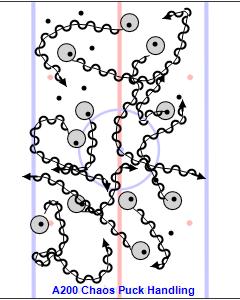
Make moves, protect the puck, go hard on the whistle. Designate moves, add pucks, play keepaway, use ball, multiple pucks, etc.Description:
1. Carry a puck and protect it while skating in random directions. Stay in the zone.
2. Go hard for about 5" on the whistle and slow down on the next whistle.
3. Coach designate the move to be practiced, i.e, tight turn when you approach someone.
4. Exchange pucks-pass with eye contact.
5. Spread pucks around which also must be avoided.
6.Keepaway-coach take a puck away every 10".Two video demonstrations:
https://www.hockeycoachingabcs.com/videos/watch/b200-chaos-puckhandling-2/https://www.hockeycoachingabcs.com/videos/watch/a200-chaos-puck-handling-1/
Attachments
'The Game is the Greatest Coach'
'Enjoy the Game'April 10, 2011 at 2:55 pm #3864KeymasterD2-200 Cross Ice Games
Key Points:
Use regular or small nets, tire, pylons or the lines on the boards for goals. Play with regular or modified rules.Description:
1. Teams of from 1-1 to 5-5 play a game cross ice.
2. After a goal allow the other team to get to centre.
3. Jokers can be added who can or must be passed to.
4. Either one or two nets can be used.https://www.hockeycoachingabcs.com/videos/watch/d2-and-d200-cross-ice-games-with-rules/
D200 x 6 Games of Kings Court – Youth

Attachments

- D2-200 Cross Ice Games.pdf (130 KB)
'The Game is the Greatest Coach'
'Enjoy the Game'April 11, 2011 at 1:24 pm #3865KeymasterB6 – 3-0 Weave-Regroup at Far End – U17-Pro
Key Points:
Principles: Pass while skating and then follow the pass and take the ice behind the puck carrier.. Fill the 3 lanes. Skate to the “big ice” between the dots when you get the puck. Pass to the outside lane, skate to the inside lane.Description:
A. 1 pass to 2 and follow the pass.
B. 2 skate to the big ice, pass to 3, follow the pass taking the ice behind.
C. 3 pass back to one, follow the pass.
D. 1 regroup with 4 and 1-2-3 fill each lane.
E. 4 pass to 1 or 3 on the strong side.
F. 1-2-3 weave the same way and attack with a triangle and shoot at the oringinal end.
G. 4-5-6 follow and repeat the other way.https://www.hockeycoachingabcs.com/videos/watch/b6-3-0-weave-regroup-at-far-end-pro/
B6 3-0 Weave-Regroup at Far End – U17

https://www.facebook.com/518555930/videos/pcb.794123934830739/10159758893775931
NHL Players
https://www.hockeycoachingabcs.com/videos/watch/b6-3-0-weave-regroup-attack-pro/B6 3-0 Weave – Regroup – Attack – Pro

https://www.facebook.com/518555930/videos/pcb.794123934830739/10159758893265931
Attachments
'The Game is the Greatest Coach'
'Enjoy the Game'April 13, 2011 at 1:28 pm #3873KeymasterB6 Pass and Replace x 3 – Youth
Key Points:
Pass while skating then turn and face the player who is passing to you. Shoot before the hash marks and follow the shot for a rebound.Description:
A. 1 pass to 2 and follow the pass and turn and face 5 for a pass.
B. 2 pass to 3 and follow the pass.
C. 3 pass to 4 and follow the pass.
D. 4 skate in and shoot-rebound- go to the corner.
# Do 2 or 3 minutes from each side. Alternate task by requiring backhand or saucer passes or a move before passing , etc.https://www.hockeycoachingabcs.com/videos/watch/b6-pass-and-replace-x-3/

Attachments

- B6 Pass and Replace x 3 – Youth.pdf (151 KB)
'The Game is the Greatest Coach'
'Enjoy the Game'April 15, 2011 at 2:20 pm #3885KeymasterT3-Body Contact Clinic – Edge Skills
Jeff Hill teaches body checking principles.
Key Points:
Start with a good athletic position of knee bent, back straight, seat low with the head on top of the shoulders and not hanging over the ice. Follow this instruction with 1 on 1 drills and transition games.
The practice was run by Jeff Hill with a group of 12-13 year olds.Description:
A. Partners bump
1. Hook wrists and bump standing then skating. Come back using other shoulder.
2. Skate apart one stride then back and bump
B. Player in the middle bump everyone around circle with each shoulder.
C. Angling both offensive with leg in front and defensive with leg behind. Get hands up on the glass to protect yourself.
D. Practice skating into the corner and making a fake then carry the puck out.
E. 1 on 1 into the corner and try to score.https://www.hockeycoachingabcs.com/videos/watch/b500-body-contact-clinic-u14/
https://www.facebook.com/tom.molloy.5836/videos/10159325153115931
T3 – Body Contact Clinic – Edge Skills

Attachments
'The Game is the Greatest Coach'
'Enjoy the Game'April 16, 2011 at 11:47 am #3891KeymasterB500 Individual Practice
Key Points:
Players work on skills of their choice and the coaches role is to give help when needed and to keep things safe. Players seldom get the chance to work on things they want or to make decisions about their development. The coach moves around to help them and see they are on task.Description:
I do this the frist ten minutes of each practice with my school skills group. They know they must be on time and be on task.
Players choose to shoot, pass, skate, play keepaway or games, they could even arrange a full ice game.
It is an individual contract where the Players decide and the coach supplies the equipment and supervision.
The coach can also suggest things for them to work on and show how to do it.Attachments
'The Game is the Greatest Coach'
'Enjoy the Game'April 17, 2011 at 12:31 pm #3892KeymasterC500 Cut Backs and Escape Moves – Youth
Key Points:
Protect the puck with the body on offense. Cut back turning toward the boards. Defender stay lined up with the back of the inside shoulder and stick on the puck.Description:
1. Leave on the whistle and practice cut backs, tight turns. Go to the net on the second whistle while the next players leave.
2. Two players leave and the second player stays on the D side with the stick on the puck and gives passive resistance.
3. This is a battle and the defender tries to get the puck. On the second whistle whoever has the puck go to the net.*Without goalies both sides can go at once and with a goalie alternate sides. Players switch sides after doing both offense and defense.
https://www.hockeycoachingabcs.com/videos/watch/c6-cutbacks-and-escape-moves-youth/

Attachments
'The Game is the Greatest Coach'
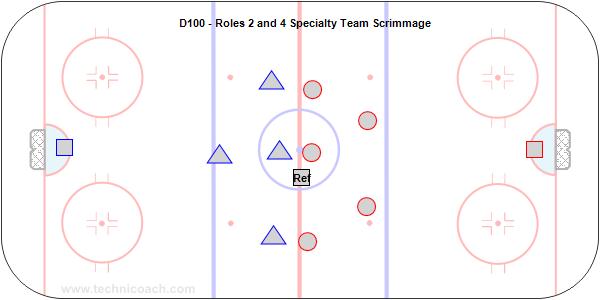
'Enjoy the Game'April 18, 2011 at 1:18 pm #3893KeymasterT2-4 – D100 – Roles 2 and 4 Specialty Team Scrimmage
It is very difficulty to practice specialty team or even strength situations with one team. Most youth teams have less than 4 lines and 4 sets of D and this makes high tempo scrimmage too difficult. Even if you do have 20 skaters the W/R ratio is too short.
When I was and asst. coach at the U of Calgary with Willie Desjardins he would arrange specialty team scrimmages with the Canadian National Team which was based in Calgary at that time. We would take turns with 5 minute pplays and work on our specialty teams.
The last few seasons I have arranged scrimmages with college teams or minor midget AAA teams to play my WWHL team and we have worked on our systems for both even and uneven situations. We did this at least 6 times last season and it is a great way to focus on systems for the pk, pp, forecheck, dzone etc.Key Points:
Divide the team into two groups and each gets a 5 min. power play with a ref. Great to play other teams in a specialty team game. Play all odd number situations 5 on 4, 5 on 3, 4 on 3. It is also a good method to practice even strength 3-3, 4-4 and 5-5.Description:
1. Arrange a scrimmage with another team.
2. Take turns with all numerical situations that happen in a game.
3. Suggested rotation with a 3 minute time out before each segment for coach to go thru the team play situation at the bench.
a. Ten minute warm up.
b. 3 minute time out 5 on 4 for 5 minutes each.
b. 5 on 3 each team and then 3' time out.
c. 4 on 4 each team and then a 3' time out.
d. 5 on 5 each team and then a 3' time out.
e. Coaches agree on a situation they want to focus on.https://www.hockeycoachingabcs.com/videos/watch/t2-4-d100-roles-2-and-4-specialty-team-scrimmage/
Attachments
'The Game is the Greatest Coach'
'Enjoy the Game'April 19, 2011 at 8:26 pm #3896KeymasterA2 – Gaston Schaeffer Skating Instruction – Youth
Key Points:
Be in a strong athletic position with the knees bent, seat down, shoulders no farther forward than the knees and the head up. The skating stride starts with a fall and about 3 forward pushes and then it is a sideways motion. When skating backwards stride sideways and don’t turn the heel to the inside. Replace the Mohawk turn with the much more efficient Transition Turn.Description:
Gaston Schaeffer leads a group of 12-14 year old girls and boys. They cover:
1. Forward long stride.
2. Forward medium stride.
3. Quick start.
4. Basic backward stride and starting.
5. Transition turn from front to back that is much more efficient than the Mohawk Turn.A2 – Skating Warm up for Agility and Balance – Jasper Camp

A – Skating Instruction and Practice – U18 F

A2 Forward Stride Mechanics Taught by Dr. Gaston Schaeffer

A5 – Crossover Basics – 5 Circles – Jasper – Gaston

A2 – Choctaw and Tight Turns – Dr. Gaston Schaeffer

A2 Backward Cross-over Principles 3 – U18 F

Attachments
'The Game is the Greatest Coach'
'Enjoy the Game'April 21, 2011 at 12:54 pm #3899KeymasterA2- Forward and Backward Stride and Choctaw Turn – Gaston
Key Points:
Practice turning from front to back and don’t lose any speed. This turn is smooth with a minimum of crossovers. (Chocktow Turn)Description:
Gaston Schaeffer teaches an efficient transition turn from forward to backward. The benefit of this pivot is that the player keeps the skating momentum.
If skating to the right the weight is on the right leg and the left skate goes behind at an angle to the turn, the player transfers the weight to the left leg and does a crossover.https://www.hockeycoachingabcs.com/videos/watch/a2-forward-and-backward-stride-and-choctaw-turn/
Attachments
'The Game is the Greatest Coach'
'Enjoy the Game'April 23, 2011 at 1:44 pm #3903KeymasterA2 – Edges and Balance Warm up – Gaston – Jasper
Key Points:
Be in a good athletic positon with the knees bent, back upright and lead with the chest and head up. Use all of the edges.Description:
Gaston leads a skating warm up.
Exercises use the inside and outside edges, proper body position both forward and backward as well as a one skate exercise that requires a good balance position and use of all of the edges.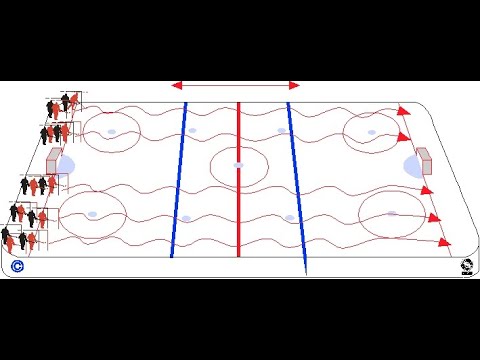
Attachments

- A2 Skating Warm up.pdf (122 KB)
'The Game is the Greatest Coach'
'Enjoy the Game'April 25, 2011 at 12:23 pm #3905KeymasterA2 Forward Stride Mechanics Taught by Dr. Gaston Schaeffer
I have been focusing on skating technique. Most coaches, me included have many skating drills. I have posted the Minnesota drills and many from Finland and Sweden and they are great. The only problem is that if we do these with improper mechanics we only teach the kid's to get "really good at bad techniuque." So it is imperative that we have proper mechanics.
I have put videos of Gaston talking about and teaching skating and I know it helps me and hope it helps other coaches.
——————————————————
A2 Forward Stride Mechanics Taught by Dr. Gaston SchaefferKey Points:
Be in a balanced position with a good knee bend. Use as much blade as possible. To start fall forward and push back the first few strides and then skate with a sideways push. The arms move opposite the legs in a back and forth motion never causing the upper body to over rotate. Lead with the head up and chest forward.Description:
I have put together various videos of Dr. Gaston Schaeffer teaching skating. Gaston has a Doctorate in Body Mechanics and taught at University in Switzerland where he was the Swiss figure skating Champion and followed that being feature skater for Ice Capades and Holiday on Ice where he toured the world. He met his wife while touring and they had a girl and a boy. Gaston was the Olympic figure skating coach for Switzerland as well as in charge of fitness for their speed skating team. He worked with Juhani Wahlsten in Davos when Juuso was coaching there.Gaston Junior demonstrates the forward stride. He is one of the most powerful skaters I have seen. He suffered a major injury at 18 and stopped playing but his technique is perfect.
The video goes in this order.
1. Gaston talking about the mechanics of the forward stride while I film him on my deck.
2. Gaston and his son doing an on ice demonstration with Gaston describing the important points of the stride.
3. Gaston leads a group through a forward skating and balance warm up.
4. Gaston teaching that group the mechanics of the forward stride starting with the long stride first, then the start and the medium length stride.
5. Gaston leading a U17 skills group. Dany Heatley came and skated with them that day. He had just won the NHL Roookie of the Year. He came as a favour to me to say hi and skate about 15 minutes but because we did transition games all practice he stayed and played and did the skating as well (he has a black sweatsuit and hat on).https://www.hockeycoachingabcs.com/videos/watch/a2-forward-stride-gaston/
Attachments
'The Game is the Greatest Coach'
'Enjoy the Game'April 26, 2011 at 1:56 pm #3907KeymasterA1 Introduction to Balance on Ice and the Sideway Motion of Skating – Gaston Schaeffer
Key Points:
We walk and run with a front to back movement of our legs. Skating is a foreign movement because it is side to side. Gaston uses balls and pucks to introduce beginners to the side to side weight transfer. Dr. Gaston Schaeffer introduces this unnatural movement along with proper skating posture with a sequence of exercises using balls, pucks, hurdles, etc.
Description:
• Walk across the ice.
• While standing on the same spot, try and bend the body in all possible positions.
• Walk to a puck, bend over, pick up the puck, return to starting point and repeat.
• While standing try to stand on 1 foot, then the other.
• Walk and then glide on 2 feet.
• Take a puck in your hand and throw it ahead of you; go to it; pick it up and repeat the exercise
until you have crossed the width of the rink.
• Walk on the ice.
• The coach spreads pucks all around on the other side of the ice. Walk to where the pucks are, by
stepping over the sticks laid on the ice. See how many pucks you can collect.
• Put hurdles on the ice (24-28"/60-70 cm in height) get the skaters to pass under hurdles to
go and collect the pucks (this forces them to bend the knees).
• Combine the going over the sticks and under the hurdles, to provide a new challenge.
• Introduce the tennis ball. Start by having skaters pass the ball from hand to hand while walking across the width of the arena.
• Try to do the same thing while skating backwards for a short period of time (to prevent boredom and
frustration).
• Develop the glide by trying to pass the ball from hand to hand as you stride.
• Introduce the bouncing of the ball while walking or gliding across the ice.
• Skate across the ice skating under and over hurdles of different height ranging from 4-28"/10-70
cm.
• Skate backwards by passing the ball from hand to hand.
• Skate backwards by trying to move a puck between your feet.
• Skate forward by passing a puck between your feet.
• Skate forward passing the puck between your feet and the ball from hand to hand. • Skate while passing the puck from 1 foot to the other.
• Skate while bouncing the ball from hand to hand at the same time as you move from 1 foot to the
other.
• Skate, passing the ball from hand to hand as you skate from 1 foot to the other.
• Skate, passing the puck between the feet and the ball from hand to hand while skating forward.
• Same exercise as above but backwards.
• Put up some hurdles – try to jump over (4"/10 cm) some and slide under others (16"/40 cm).
• To increase the level of difficulty, add low hurdles, asking the skaters to first step over them while bouncing the ball on the ice.
• Spread pucks around the ice – the players move around the ice and pick up the pucks by bending their
knees and keeping a straight back. They then put the pucks into the puck bag. This activity works on the
proper skating posture and balance.
• Skate forward and hop over a low hurdle then, as quickly as possible, turn around and catch the
ball thrown by a teammate or coaching assistant.
• Same as above but upon landing turn around in the opposite direction.
• Skate forward and hop over the hurdle, then fall in a roll – get up, turn around and catch the ball.
• Same exercise but the other direction (turning around the other way).
• Jump over a hurdle, crouch under the next hurdle then do a slalom around 5 pylons on 1 foot, then jump over the last hurdle and catch the ball as you jump.
• Repeat the same exercise but doing the slalom on the opposite foot.
• Skate forward and stop – as you stop, you will catch the ball thrown to you at the same time as the command.
• Skate backwards – at the command turn around as your the partner throws the ball for you to catch.
• Same exercise but turn around the other way.https://www.hockeycoachingabcs.com/videos/watch/a1-weight-transfer-with-balls-and-pucks/
Attachments
'The Game is the Greatest Coach'
'Enjoy the Game' -
AuthorPosts







- You must be logged in to reply to this topic.