Home › Forums › Talk Hockey › Game Intelligence / Decision Training
- This topic has 238 replies, 9 voices, and was last updated 10 years, 8 months ago by
Tom Molloy.
-
AuthorPosts
-
July 12, 2012 at 4:37 am #6433
Tom Molloy
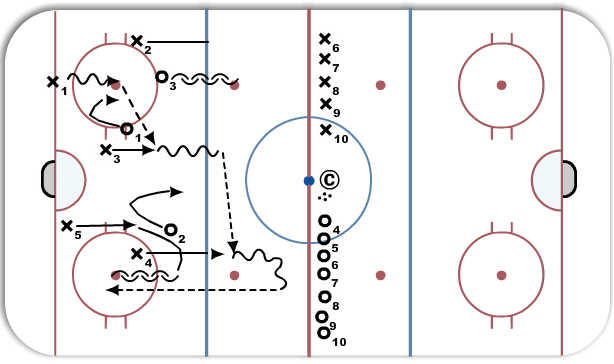
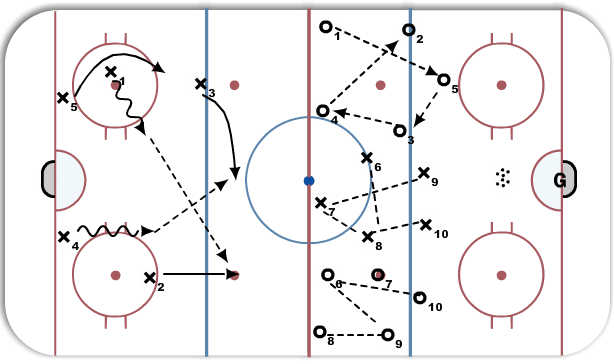
KeymasterI wouldn't go so far as to cast them as Evil Drills but coaches use drills way too often. Drills are an important part of the Coaching Toolbox but not the whole toolbox. I will probably use some of the drills I saw today as tools to teach some concepts. The 2-0 could be used to practice shooting one timers or else taking the shot from the wide lane and putting it low to the far side to cause a rebound (rebound pass) I would add other components to the other drills. This would be the teaching part of the practice and then we move into games and transtion games. I like to use games fifty to eighty percent of my practices.
Technique drills are very important in player development. The technique then needs to be put into a competitive situation.
I agree with keeping score and I do use tournaments in pracitce. I don't think it is necessary to punish the loser. In Kohlbergs order of maturity the lowest level is doing something 'for fear of punishment'. I would rather have players motivated intrinsically and not extrinsically. Be motivated by the joy of winning or the hatred of losing. I do have the loser do something like laps sometimes but just for fun. Jusso often has the winner do laps because the loser is already upset.
So if drills are about 25% of practice and they are efficient and isolate something that needs to be worked on then I think they are very beneficial.
'The Game is the Greatest Coach'
'Enjoy the Game'July 13, 2012 at 7:44 am #6442hockeygod
Participantgaffz4 wrote:
Malkin is bringing his trainer to Russia again this summer. He said Malkin won't get on the ice until August!!!!! If it is good enough for Malking, why do we insist on getting kids on the ice in the summer?http://www.nhl.com/ice/news.htm?id=637783
Bob
To answer your question about why we insist kids should get on the ice in the summer… after a bit of thinking, there are several things to consider.
A week or two of hockey school or power skating instruction are good platforms to work on building sport specific skills. If people want to practice their hockey skills off ice, they can do sport specific stuff with 'fake ice', slide boards, hockey balls, etc.
Malkin is an adult with fairly proficient skills; as attributed by his League MVP Award! He is talking about getting on the ice in August. Most pros do this to start to convert their physiological gains from the gym (and dryland) to a more sport specific venue (practice their Sport Specific Skills). Skating (while dribbling / passing / shooting a puck) is not a natural motion and it takes this lead time to get the neuromuscular and skeletal systems ready for training camp and the competitive season.
EDIT: I should add that after a long season, elite (junior and above) players need to get off the ice for a stretch of time. At least 2 weeks of active rest; could be longer depending on the player, injuries, the length of season (how far into the playoffs did they go this year and any cumulative effects from previous years playoffs / starting the year in Europe, west coast vs east coast teams, etc.)
But back to youth hockey – no doubt, there are bucketful’s of money to be made from unsuspecting, or overly keen hockey parents! Spring and summer hockey (training in general) has become a commercial enterprise and it looks like it is here to stay. Caveat Emptor to the consumer…
I liken it to an arms race and sadly, I see it starting younger and younger all the time. For instance this year I saw someone locally start a Timbits Spring Program (4-5 YO's) that ran for 2 months; on the ice twice a week for 60 minutes per session. He had 40 kids per session with two session’s back to back (so 80 kids total) and he had 20 on a waiting list… all this within 24 hours of sending out a mass email! He hadn't even paid for the ice time or bought insurance yet; not to mention this was his first year of coaching and he himself didn't play above midget! (His son started Timbits this past year so 'dad' wanted to get extra ice for his boy… it really took off!) He made over $10,000 on this program after expenses, so this shows there is money to be made…
Speaking of skill development: Guess what happens when someone gets extra exposure to a novel skill (regardless of the quality of instruction)? They get better (often due to their own trial and error process… one can argue it's the 'opportunity' or exposure to extra time, facilities and / or coaching that cause the improvement. Just read Daniel Coyle's blog and his book, "The Talent Code".)
In this Timbit example, spring training added an extra 16 hours of instruction to a first year players total of 40 hours of regular season practice and 6 – 10 hours of 'games' (multiply that by 2 for a 2nd year player)… so spring training equals almost another 40% of training (half a season!) in the two month program when looking at total hockey training time for a first year player. Those players should be 40% 'better' than before!
When these kids tryout next season and lo and behold, they are better than when they finished the past season; especially when compared to those kids who didn't take a spring or summer hockey program, other parents see this 'talent discrepancy' and think if they don't jump on the bandwagon, their kids will get left behind! So even more people enroll the following year… and it continues to suck more and more people in. Everyone is trying to give their kid the best chance to advance to the highest level possible. “The road to Hell is paved with good intentions…”
Once kids hit 14 or 15, if they are serious about hockey or late specialization sports, they should start to specialize a bit more and focus on two or three sports only; as they get older, drop the focus to two and then eventually (sadly) to one.
Read about the LTAD recommendations here:http://www.canadiansportforlife.ca/learn-about-canadian-sport-life/ltad-stages
Dean
M.Ed (Coaching)
Ch.P.C. (Chartered Professional Coach)
Game Intelligence Training
"Great education depends on great teaching."July 13, 2012 at 6:35 pm #6444ParticipantTomM wrote:
Dean, did you see anything worth noting at the on ice session. Maybe they will surprise you and have something besides some drills and full ice scrimmage.I stopped at COP on my way home from British Columbia and met my assistant coach Sean there to give him some of the cherries I picked. I thought of going and watching but I had just driven 9 hours and the parking lot was packed. I will go tomorrow morning to take a look.
Tom,
The day we were both there was the best day. The other days it was all mindless drills. Yesterday it got so bad that John left and the kids were so bored (the coaches talked at the board incessantly, eating up several minutes at a time while the drills only went for a couple of minutes), that I left after 30 minutes too.
The kids and I went to the rink beside it and watched figure skating for 45 minutes. Much more entertaining. Interesting to observe another sport (individual / artistic / early specialization.) Six coaches standing around the perimeter of the ice and 13 athletes. One coach was filming with his iPad and showing one of his athlete her attempts to complete a difficult jump. She kept trying the entire session and wasn't able to land one properly – she fell countless times, but kept trying. Another coach used a harness to help a young skater learn a jump. All coaches were able to provide demos to their athletes and they were all paying attention the whole time – no 'spectator coaches'. (I wish I could have heard what they were saying to determine 'how' they taught. Were they inspiring? Were they creating hope? Were they using guiding discovery?) There was lots of trying (internal motivation, passion?) on behalf of the athletes, self-discovery, and activity. Made me appreciate Daniel Coyle's Talent Code writings even more.
We can read or postulate theories all we want but at the end of the day, it is about experimentation – what works (and doesn't work) for us and others. The world is one big experiment and we are all part of it! The more I coach, teach, read, research and observe others, the closer I get to capturing "The Grail" of Best Practices Coaching. (I think I am really close now but the 100% end always keeps moving just out of reach – which is good because it keeps driving me to chase it!)
I didn't go for any of the scrimmages but John did. Today he said the morning session today was a controlled scrimmage. No refs, no score clock or scoreboard but they took turns playing even strength, PP and PK. John was quite disappointed that it wasn't more of a 'real' game with all of the above mentioned features in place and I concur. Why not cap the week with a big tourney / event – build up to it all week? (This will be part of my diatribe on how I would run this thing if I was in charge…!)
I need to go back to read your comments from some of my postings… I will do my best to respond when I get more time (if!!!) I am running 'daddy daycare' this summer while I deal with my concussion from the car accident and dealing with kids scared of thunder at night has me running around at all hours of the day! But some great discussion items posted here by you and some of the other coaches. They really get me thinking. When I get time, I will keep posting (patience please!!!!)
I hope everyone will keep contributing over the summer. It is a great part of my day to get on here and read new posts. It helps keep my brain engaged and makes me a better coach!
Thanks to all who are contributing!
Dean
M.Ed (Coaching)
Ch.P.C. (Chartered Professional Coach)
Game Intelligence Training
"Great education depends on great teaching."July 15, 2012 at 1:30 am #6447Tim Taylor
ParticipantThe rink where Johnny Gaudreau grew up skating is not far from where I live. We play games there regularly. Someone who is closely affiliated with the rink told me the following about Johnny G.:
The big thing with Johnny is that he grew up on the ice. He LOVES hockey, more than any other player or fan I've ever met. He always wants to be on the ice, never gets burnt out. That is the love that drives purposeful practice. John is a student of the game. He thinks it better than everyone else-that's why he's so successful despite being drastically undersized. If there are things to be taken from his story, they're:
1. Let kids develop a love for the sport (or any other sport) and let their interest dictate how much they play throughout the year. NO pressure from parents.
2. Study the game. There is a lot that can be learned about anticipation and reading the play by watching hockey critically. John does this constantly, probably without realizing it.July 15, 2012 at 2:38 pm #6448Participanttrtaylor wrote:
The rink where Johnny Gaudreau grew up skating is not far from where I live. We play games there regularly. Someone who is closely affiliated with the rink told me the following about Johnny G.:The big thing with Johnny is that he grew up on the ice. He LOVES hockey, more than any other player or fan I've ever met. He always wants to be on the ice, never gets burnt out. That is the love that drives purposeful practice. John is a student of the game. He thinks it better than everyone else-that's why he's so successful despite being drastically undersized. If there are things to be taken from his story, they're:
1. Let kids develop a love for the sport (or any other sport) and let their interest dictate how much they play throughout the year. NO pressure from parents.
2. Study the game. There is a lot that can be learned about anticipation and reading the play by watching hockey critically. John does this constantly, probably without realizing it.Passion drives one to learn more about their field. Great comments!
I am heading out for a Canadian soccer LTAD presentation this morning. Gotta get my coaching fix!
Dean
M.Ed (Coaching)
Ch.P.C. (Chartered Professional Coach)
Game Intelligence Training
"Great education depends on great teaching."July 16, 2012 at 5:17 pm #6454ParticipantI attended a Canadian Soccer "Sport For Life" certification class this weekend. The Colombian, John Castrillon, presented to nine community coaches (Div 1 and below – various age categories and genders). The seminar used a classroom setting (overhead / powerpoint / small group work / individual journaling) and the minor soccer office had warehouse space where they created a mini indoor field – lines on green indoor / outdoor carpet with goals at each end – so the players (coaches) could be positioned like chess pieces (or use pylons to show 'set plays') and then the Colombian's U12 and U16 teams came so the nine coaches could take turns delivering parts of lessons (outside on the soccer pitch across the street). John observed and later provided feedback to each coach. He showed the coaches some of his games – that was the biggest 'hit' of the weekend for the coaches.
I liked how the LTAD was incorporated into the certification process. Soccer is really starting to provide some intelligent delivery content. I want to sit in on some hockey certification courses this fall to compare and Hockey Canada / NCCP / Coaches of Canada have been working on yet more changes…
I am going to attend the newest NCCP offerings through the National Coach Institute next week. I worked on some of these modules (hockey specific) so again, it will provide an interesting perspective sitting through these as a 'participant'. I will update after the fact (later in July).
Dean
M.Ed (Coaching)
Ch.P.C. (Chartered Professional Coach)
Game Intelligence Training
"Great education depends on great teaching."July 16, 2012 at 5:33 pm #6455ParticipantHere is an article I just received from Bruce Brown of Proactive Coaching.
The Difference between Impact and InfluenceKevin Bryant, http://www.proactivecoaching.info, July 16 2012
"The Place God calls you to is the place where your deep gladness and the world's deep hunger meet." Frederick Buechner
Most of us coach/athletic administrator types might not be able to explain totally our love affair with sport and student. We might fumble around a bit to share with others that we cannot not do what we are doing. Be you a person of faith or not I would say that in the end we each have experienced some type of “calling” to do what we do. We love sport, we are passionate about the lessons that can be taught by our involvement in it and we love the very essence of practice, preparation, relationships and reaching something for us a bit out of our reach goal wise. Some of us do this sport thing because we want to give back to those coming after us. We want to say thanks to those coaches and athletic administrator types who have connected with us and helped to change our lives. Some of us do this because we love students even more than the sport(s) we love. We love seeing what takes place though challenge, teamwork, sacrifice and commitment in the lives of those placed under our care. Whatever your motivation, it is my hope and prayer that you have sensed a “call” to do this critically important work in such a clear and unmistakable manner that despite the challenges presented by this work you cannot imagine doing anything else.
The National Federation of State High School Associations (NFHS) in their coaches education training states that mastering four ingredients are necessary for one to become a successful coach. The four area’s where expertise is needed include tactical expertise, technical expertise, relational expertise and organizational expertise. Most of us have an immediate reaction as we read these four qualities of a successful coach. We know which area we are most adept at and which one we are not. The others may fall somewhere in the middle. Our credibility as a coach often comes from our tactical and technical abilities. We might feel best about our coaching work because we are able to impact a game and skills of the participants. However in my 30 years of coaching and athletic administration work I have rarely observed lifelong change take place in the life of a student athlete coming from these two areas. Devoid of relational connection to these two important area’s the overall outcome we normally associate with that of athletic participation falls flat.
Impact in the life of a student athlete does not take place by accident or by osmosis. When a student athlete is struggling and is in a moment of crisis I have yet to see that person reflect upon that amazing out of bounds play drawn up by that coach so long ago and that will make everything OK now. In that moment of need, fear and struggle what will remain is what a coach or athletic administrator type did to impact that student athlete. Not by accident but on purpose and for a specific reason. To impact the lives of students in this purposeful way several things must be in place for this coach to have “lifelong” impact.
Lifelong impact takes place because it is part of the practice plan for the day, week, month, year of that sport. Are there “natural” lessons that a sport teaches? I am currently playing a ton of tennis. I love it. I play at 5:15 am three to four days a week. I love starting my day with a tennis racquet in my hand. One lesson that I am learning (it seems over and over again) is that I must recover at game speed. I don’t have time to mess around when I make a mistake the next tennis point is coming. My teammate (if doubles) does not have time to wait for my attitude to adjust I must maintain poise and focus. Do we ever need to help impact the lives of students so that in their moment of need later in life they will “recover at game speed” and deliver the poise and focus that they learned from us on purpose and with intent. It is the gift that keeps on giving, We train ourselves and our student athletes in these “life lessons” so that when they face them they are not surprise and can perform their best. Five years ago my wife, Sara was diagnosed with breast cancer. It was like getting hit on the head with a mallet. We spent some days getting to know our new reality then set to overcome it. My wife’s training as an athlete and teacher and mine as coach and athletic administrator type were critical to our ability to “recover at game speed” and begin to mount an offense against this deadly opponent. I am thankful that five years later Sara is in great health and is back to teaching her elementary school students. Her attitude made a HUGE difference in her recovery and it started by not asking why me? Instead she went on the offensive and said why not me? Let’s get busy kicking cancers butt. Her attitude forged by her participation and lessons learned as an athlete and teacher made the difference. She is one of my hero’s.
Impact is messy. It is not a quote from a book, it is not shown through 100 practices or drills, it takes place as we leave our comfortable space and decide we will get through to a student. It can take place in any number of ways. But it starts with our heartfelt desire to have impact on the lives of our student athletes., Influence might look like a few “strong suggestions” that would work if the student is so motivated. Impact says I am not giving up on this student learning this life lesson because I can tell that it will make the difference in their life now and for the long haul. Easier and less costly to influence this person to try to some new behaviors on vs. demand that they do this. Influence says we don’t have any rules, just as few strong suggestions. Impact says do this or else. To say this to a student challenges each of us to know our athletes in such a way that we know what they need. This happens as we spend time, observe, care and jump in with them to make life the best it can be. Once impacted these young charges will be different forever, this is an effort worth our very best.
Impact is not an individual but a team effort. Influence says please don’t go out and drink this weekend team. Impact says to our captains and other influential parents and coaches, hey we are having a monopoly (ping pong, bowling, battleship, etc) tourney this Saturday night at my house. As we give others permission and actively seek their partnership we impact lives well beyond our original scope. We are teaching our team how to become good teammates, looking beyond themselves to help others with altruistic motives. They might be initially put off by trying to help a teammate they feel is on the wrong track, this will give them a practical way to care of their teammates that involve everyone on the team.
One of the toughest lessons for those of us who want to impact our athletes vs. influence them comes from the question asked in the movie Untouchables from Sean Connery as he laying dying on the floor of his home…looking into the eyes of Kevin Costner as Elliot Ness he says “What are you willing to do”? to get the job done? In this case the job was to arrest mafia figure Al Capone. So I pose the question to you dear reader. You have been called to this amazing opportunity to impact the lives of student athletes through sport. It will not be easy, it will be costly and if your impact is to be lifelong it will come from your own willingness to be vulnerable, teachable and changed yourself. Are you so willing? An immutable principle of leadership is “you first”. Influence says, here student athlete take your medicine it will be good for you! Impact says I know why this is so important for you because I went through something similar to you and overcoming it has made all the difference in my life, it will be the same with you! And oh by the way I am here to help you work this through. I won’t be walking away from you I am committed to see the job through. Are you in?
I am lucky that my college basketball coach, Chuck Randall head coach at Western Washington University was committed to me and my teammates in the ways I describe above. He was the rare individual who would say the hard thing as well as the encouraging thing. He was not afraid to share his own struggles and challenges. He was a man of faith that was not intimidated to share what had happened in his life. He believed in his athletes and did whatever he could to support them and help them to be their best. He was unafraid to share his care for me as a person as well as an athlete. I learned much about basketball from him but learned even more about life. His life spoke of IMPACT. I think of him constantly, now 54 years old and 33 years removed from the experience of his direct coaching, care and friendship. He has imprinted his life on my life. When I began to coach I wanted to impact the lives of those I coached like he had impacted my life.
Choosing to impact the lives of others must be a deliberate decision. Influence is a maybe, impact is a for sure. Influence is suggestive, impact is demanding. Influence is somewhat impersonal, impact is my life on your life. Impact is rock solid. Impact is practical. Impact is purposeful. Impact is sharing what you know and how you came to know it. Impact is difficult. Impact is costly. Impact will make you your very best.
“To every person there comes in their lifetime that special moment when they are figuratively tapped on the shoulder and offered the chance to do a very special thing. Unique to them and fitted to their talents. What a tragedy if that moment finds them unprepared or unqualified for the work which would have been their finest hour.” Winston Churchill
Are you called to impact or influence?
Kevin Bryant is currently a Vice President at Warner Pacific College in Portland, Oregon. He has been involved in athletic administration at the high school and college level and in 2007 received the NFHS Distinguished Service and Citation Award. Kevin is a great friend of Bruce Brown.
Dean
M.Ed (Coaching)
Ch.P.C. (Chartered Professional Coach)
Game Intelligence Training
"Great education depends on great teaching."July 19, 2012 at 6:12 pm #6467ParticipantThe Lead Is Safe: How to tell when a college basketball game is out of reach.
By Bill James, SLATE.com, March 17, 2008
http://www.slate.com/articles/sports/sports_nut/2008/03/the_lead_is_safe.single.html
Question: How do you know when the contest is not officially "over," but the outcome is no longer in doubt?
Answer: How would I know? I was a Huckabee guy.
With apologies to the Sage of St. Louis, there comes a time when it ain't over, but … it's over. There comes a time in a relationship when a woman will still answer your phone calls, but you're wasting your money buying flowers; you know what I'm saying? There comes a moment during a job interview when you're still talking, but you might as well take off your shoes. There is a time in an illness when you're not dead yet, but you might as well stop taking that nasty medicine.
There is a line there somewhere, and how do you know when the line is crossed that separates hope from fantasy? If we're talking politics, romance, job interviews, or medicine, I don't know. When it comes to college basketball, I've got a theory.
This thing has a 40-year history, actually. I've been attending basketball games at Allen Field House in Lawrence, Kan. (home of the Jayhawks), since 1967. The Jayhawks usually win by 15 or 20 points, and sometime in about 1968 I started wondering whether there wasn't some way to decide when the game was no longer in doubt. I began to experiment with heuristic inventions to try to find the moment at which the line was crossed. A heuristic could be loosely defined as a mathematical rule that works even though no licensed mathematician would be caught dead associating with it.
Let's see … what about: The game is over when the number of points you are ahead (or behind) is more than one-tenth the number of seconds left in the game? *
Nah, that doesn't work. If you're 30 points behind, the game is over much more than five minutes out (300 seconds); if you're two points behind, the game is not over when there are 20 seconds left. The rule doesn't work on either end.
Eventually I found a rule that did work at that time, but at that time there was no 3-point shot in basketball. When they added the 3-point line, I had to recalibrate my system.
OK, I've stalled as long as I can. You ready?
Take the number of points one team is ahead.
Subtract three.
Add a half-point if the team that is ahead has the ball, and subtract a half-point if the other team has the ball. (Numbers less than zero become zero.)
Square that.
If the result is greater than the number of seconds left in the game, the lead is safe.(If you don't have a calculator handy, use the tool below to do the calculations for you.)
If you've got a 10-point lead and the ball with 10 minutes left, is that a safe lead?
Of course not; teams come back from a 10-point deficit all the time. A 10-point lead, plus the ball, gives you a 7.5-point safety margin. It's safe for 56.25 seconds—56, rounded down. With 600 seconds to play, a 10-point lead (with the ball) is 9 percent safe. That doesn't mean a team with a 10-point lead and the ball with 10 minutes to go has only a 9 percent chance of winning. Rather, it means they're 9 percent of the way to having a completely insurmountable advantage.
An 11-point lead with nine minutes to play—we'll let you keep the ball. That's an 8.5-point safety margin with 540 seconds to play; it's 13 percent safe (72.25 divided by 540).
A 12-point lead with eight minutes to play … that's a 9.5 point margin. It's 19 percent safe (90.25 divided by 480).
A 13-point lead with seven minutes to play … 26 percent safe.
A 16-point lead with four minutes to play … 76 percent safe, assuming the team with the lead also has the ball. It's really unusual for a team to come from 16 back with four to play and win, but it does happen. I would guess it happens twice a year somewhere in the world of college basketball.
A 17-point lead with three minutes to play … bingo. That's a safe lead. Seventeen points with three minutes to play is a safe lead whether you have the ball or not, actually; a 17-point lead with the ball is safe at 3:30; a 17-point lead without the ball is safe at 3:02.
Once a lead is safe, it's permanently safe, even if the score tightens up. You're down 17 with three to play; you can make a little run, maybe cut it to 8 with 1:41 to play. The lead, if it was once safe, remains safe. The theory of a safe lead is that to overcome it requires a series of events so improbable as to be essentially impossible. If the "dead" team pulls back over the safety line, that just means that they got some part of the impossible sequence—not that they have a meaningful chance to run the whole thing.
Why calculate when the lead is safe? The real answer is "because I like to." I like to feel that I understand little things about sports. I like to feel that I can see the difference between a safe lead and a live contest for the same reason that I like to feel that I can recognize a zone defense and recognize a pick-and-roll.
But if that answer doesn't work for you … you pay a price in sports for anything you believe that is not true. The fact is that everybody around a college basketball game—the coaches, the announcers, even the referees at a lower level—calculates when the game is really over. They calculate it with intuition and guesswork. When the lead is judged to be safe, the coaches empty the bench. When the lead is judged to be safe, the announcers start re-ranking the top 25 and talking about the upcoming games or the next-round matchups. When the lead is safe, the Jayhawk fans start doing the slow, spooky Rock Chalk chant. I love that.
If a coach misjudges the moment at which the lead is safe, he can empty the bench too early and get himself into trouble. I've never actually seen a coach lose a game that way, but I certainly have seen coaches misjudge when the lead is safe, empty the bench too early, and get hit by a haymaker. More commonly, because coaches are afraid that that might happen, they continue to compete after the game is beyond any reasonable possibility of a reversal. That has consequences, too. You can get a player hurt playing for nothing. You can miss the opportunity to get a little bit of rest for players who are tired at the end of the season but have a game on Saturday. You can miss the opportunity to get that 12th man his 20 seconds in an NCAA tournament game—and if there's no value in that, then why do they do it?
And I think we've all seen games in which the announcers misjudged the moment when the lead was safe and started talking about the consequences of an outcome that was never to be. Probably announcers don't enjoy doing that.
I have never personally seen a game in which a team lost after having a safe lead. In February 1994, LSU led Kentucky by 31 with 15:30 left to play, only to see Kentucky rally for a 99-95 victory. That was impressive, but a 31-point lead without the ball is safe for 12:36. The lead was 81 percent safe. And then this year, LSU blew a 15-point lead to Villanova with 2:59 to go—which, again, is close but no kewpie doll. With 179 seconds to play you need a 13.5-point margin, which means a 16-point lead with the ball or 17 without. The curse of Dale Brown. Actually, I would guess Dale was cursing up a storm when that happened.
My editor, doing his due diligence, found one game in which a team lost after holding a safe lead. On March 2, 1974, North Carolina trailed Duke, 86-78, with 17 seconds to play—a safe lead for Duke. Duke had repeated misadventures in in-bounding the basketball and wound up losing the game in overtime. That was before the human typo was hired to coach Duke, but … does anybody know where I could get a tape of that game?
My little formula, over the course of 40 years, has wormed its way into our family's college basketball experience. Early on in every game, usually once in the first half when the score is about 23-21 and again midway through the second half, I will observe soberly, in my best faux-expert voice, that "the lead is not safe," and my wife will look at me not only as if I were an idiot, but as if for some reason she is surprised by this. In the closing minutes of a tense game, it gets serious: "Is that it? Is the lead safe yet, Dad? How much more?" They are waiting to exhale, waiting to unbundle their nerves. They know that every time the clock stops, when I should be scoping out the cheerleaders, I am recalculating the lead in the back of my head. I've been doing it so long, I can do both at the same time.
I hope you get something out of it.
And if you do, tell Ralph Nader. It's over, man. Go home.
Correction, March 17, 2008: This piece originally misstated a possible heuristic for determining whether a basketball lead is safe. Rather than "[t]he game is over when the number of points you are ahead (or behind) is more than 10 times the number of seconds left in the game," it should have read "more than one-tenth the numbers of seconds." (Return to the corrected sentence.)
—–
After finally watching Moneyball last night (great movie by the way) I wonder if someone can come up with something similar for hockey?
I hated the book because it was so slow moving. To the best of my recollection, it wasn't anything like the movie. Plus I hate baseball – far too slow of a game for me – even though I played it for a bit as a kid. I quit after two years because I was bored silly. I am a transition sport kinda guy!
Tom Renney told he and the NY Rangers were using what they learned from Sabremetrics / Moneyball (after the book came out in 2003) to fine tune their scouting department (and to help them make trades.) I should have taken that job with them working with their development squad back in the day and maybe I would have learned more!
Obviously pro teams (hockey) are not willing to share any of their info as it is a competitive market!
Dean
M.Ed (Coaching)
Ch.P.C. (Chartered Professional Coach)
Game Intelligence Training
"Great education depends on great teaching."June 22, 2015 at 3:49 pm #7546Kai K
ParticipantHi all!
Had to bring this up. This is great topic with some great posts from Tom, Dean and other coaches.
Here is a good video from Mark Upton on the issues discussed here in this topic.
it really makes you think why would you use any 1-0, 2-0, 3-0 etc. drills any more? of course there's still some use for the drills, e.g. skating technique.
I try to add some kind of decision making or pressure to those drill, e.g. 2-0 passing drill where passing isn't pre-determined.
——————————————-
Kai great to hear from you. I really miss the discussions we used to have on this board.This was a terrific discussion and I invite any coach to jump in.
Some coaches believe that it works best to play the game FIRST to create a NEED to KNOW and then do corrective exercises (drills) for technique, followed by the game again. i.e. Introduce backhand passing and play a game where there must be at least 3 backhand passes before you can score. Let the players struggle with the skill and tell them they will play the game again after you give them some ideas about 'how to make a good backhand pass'. The coach then gives some instruction and an exercise to practice and then go back to the game.
To make drills more game-like put a time limit on them; i.e. 3-0 with 10" to score and keep track of which group scores the most or the quickest.
Same with situation drills. Create a contest between the offensive players and defenders. How many goals scored in a certain time. Another idea is to create variable situation drills. Instead of doing a sequence of 1-1, 2-1, 2-2, 3-2 send players out randomly and get the same situations but the players have to read them. i.e. Send 1 to 3 forwards and 1 or 2 defenders.
Transition games are seldom used in Calgary but are the logical progression from drills. They are game-like because only one puck is used and the new defenders and attacker join either actively or passively to support. Again you can vary how many new players support, which creates a different situation each time and you can have the original F or D or both join the next rush.
Even a game like keep-away can have special rules and scores can be kept. i.e. 3-3 keep-away and only forehand passes are allowed and the team gets 1 point for every time they can make 5 consecutive passes.
SAG tournaments can replace practice drills. Have modified rules for each game. i.e. Game one – all must touch the puck. Game two – only two seconds with the puck. Game three – you must make an escape move before a pass or shot and goals only count on one touch shots. Game four – only one pass is allowed then you have to score on your own. Create a round robin tournament and keep track on your coaching board. Give rewards/punishment after.
Your role as a coach changes a lot with this method. All the players are moving, so you are not the traffic cop running drills but instead you enforce the rules and during drills and transition you talk to the players when they return to the line-up and have a short debriefing between games in the tournaments.
Three years ago I filmed a U18 girl's drill based practice. I kept the camera on one player for 45' who has a green helmet, white socks and shoots right. It is a drills based practice. When you do this you realized how inefficient drills practices are. How much do they move. How much will transfer to the game, is it any fun? https://www.dropbox.com/s/l57zoytlfepx2zp/T%20-%20Inefficient%20use%20of%20the%20Ice%20Example.3gp?dl=0 Most studies have players actually doing something for between 7-12' and standing around 48-53'.
And we wonder why kid's quit playing.
Tom
Coaches – what are your thoughts. I would recommend you take a look at the previous postings in this thread.
Kai
June 29, 2015 at 5:58 am #7549ParticipantI like to start practice with some kind a game or a passing drill that has decision making
e.g.- 1/2(or 2/3) ice 5v3 keep away/ re-group. where 5 offensive player try to keep possession as long as they can or for a preset time e.g. 45 seconds. So one sequence can take less than 1 second or 45 seconds. tape to tape passes no rimming the puck. On a re-group version of the game when puck is over blue(/or red)line 5- man unit must turn back and re-group.
- 1/2 ice 5-0 passing drill with 2-4 pucks, resting players do stationary passing with 2-4 pucks on the other half of the rink.
- skills SAG's, puck only on fore/back hand, only backwards skating, one touch passing etc.
- warm up passing around the rink, when you receive the puck speed up/ turn around/ do 360/. or passing rules, no return pass, return pass.
Kai
———————————————————————————
Kai, great warm-up that demands problem solving, skills, nervous system overload, competition. It will get your players ready both bhysically and mentally.
TomAttachments
Kai
July 8, 2015 at 2:25 am #7557KeymasterKai, great topic and thanks for trying to get a discussion going.
I tried to email you but got it back. Must be old address.How are things in Finland?
'The Game is the Greatest Coach'
'Enjoy the Game'July 8, 2015 at 10:39 pm #7559ParticipantTomM wrote:
Kai, great topic and thanks for trying to get a discussion going.
I tried to email you but got it back. Must be old address.How are things in Finland?
Thank you Tom, It would be great to get this forum going again. It's great that you're keeping it alive, it's a great resource for all coaches
that's weird because it's the e-mail address I use.
Things are good here. I keeping an year off from coaching (need to spend some with the family too) although I've promised to coach our club's U16 D's. Do one ice practice in a week and see their home games etc.
And of course update my coaching knowledge and philosophy. I'm planing really to focus the game intelligence and decision training. I have a pile of books waiting to be read.How about things there in Canada?
Kai
———————————————
Things are good. I leave tomorrow to Santa Rosa, California to play in a tournament and then my wife and I will stay in the wine country near there a day and San Francisco a few days and come back July 18. When I get back it is off to Vancouver for The Coaches Site Hockey symposium, which was very good last year. We then have our camp in Jasper Aug. 10-14 where the focus is Skating and 'How to Play the Game' (you would enjoy this camp as the hockey sessions are 80% SAG's with modified rules). It should be fun.I am doing private sessions with a few players. One girl I have trained for 4 years is going to the NCAA on a full ride in Sept.
The Flames have their prospect camp right now and are doing a lot of skill circuits. It is like a big hockey school and they are really working on the details of the game. Lots of agility skating with everything.
I am going to coach U18 Boy's this year and looking forward to it. I am also going to be an mentor for the AAU hockey focusing on practice for various levels.
You will have more time for your family this year. I just read 'The Brain that Changes Itself' and 'The Brains Way of Healing" by Doidge am reading 'The Power of Habit' and "Think Like a Freak' which are all great books on how we learn and how to affect group cultures, which are relevant coaching topics.
Enjoy your time off and keep contributing to the Forum. Maybe start your own Thread that focuses on how hockey is coached in Finland and Game Intelligence.
Tom
Kai
January 12, 2016 at 5:27 pm #7754KeymasterGood Habits and Effective Play – Develop Elite Players
Traveling around to different arenas in the city and basically around the world the thing I notice is that there is little attention payed to playing with good habits or the transition from offense to defense to loose puck situations.
Game sense can only be developed by playing games and good habits have to happen in these games.
Last night I mentored a U13 team and we played with the rules you must have your stick on the ice and you must face the puck. These are core requirements to be successful but are not emphasized in practices I watch.
Today's skill class featured overspeed puck handling ending with a give and go then a shot and then the players hot and defended vs. the next shooter. So the skills were chanllenged.
The players then played 7 games of 1-1 with 3 regular nets with goalies and 4 small nets.
We moved to 2 games of 2-2 and one of 3-3 with a two pass rule.
Rotatated nets and the rule 'goals can only be scored on give and go plays.' This practices the fundamental of all games with nets.
Rotated again and played two pass with give and go and goals must be scored on one timers.
Thee simple rules teach some of the biggest concepts in the game.
TM Sports has had a lot of success helping players move to the next level. Last season, only counting players who spent at least 60 hours on the practice ice, 12 were playing pro, 3 in the NHL and the rest in Europe. Three major awards, Hobey Baker, NHL Rookie of the Year, Finnish Elite League Rookie of the Year. 15 girl's were playing college hockey in Canada or the USA.
I think this shows that game understanding and good habits are essential elements that need to be worked on for players to move to the highest levels.
The point of this site is to give coaches ideas on how to accomplish this. The games and transition games described on the site are two practice methods that can separate your program from others.
'The Game is the Greatest Coach'
'Enjoy the Game'February 11, 2016 at 4:48 pm #7772KeymasterThis is a great article on giving feedback when mentoring or coaching.
“I’m giving you these comments because I have very high expectations and I know you can reach them.”
http://www.getsportiq.com/2014/10/the-secret-that-increases-effort-40/
'The Game is the Greatest Coach'
'Enjoy the Game' -
AuthorPosts
- You must be logged in to reply to this topic.