Home › Forums › Talk Hockey › Daily Drill Section Eleven
- This topic has 157 replies, 2 voices, and was last updated 2 years, 3 months ago by
Tom Molloy.
-
AuthorPosts
-
September 10, 2012 at 4:23 pm #6578
Tom Molloy
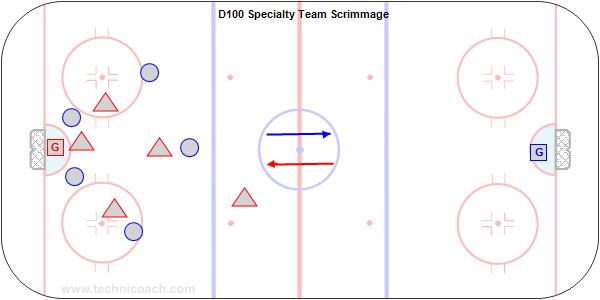
KeymasterD100 – Specialty Team Scrimmage – Player in Neutral Zone
Key Points:
This is a game from our book. I use the games all of the time but since this site is meant to update the ABC manual I haven't posted it. It is a very good way to practice specialty teams especially if you have less that 4 sets of 5. You can create any even or odd numbered situation at each end of the ice.In order to create the various situations that happen in a hockey game, play 5-on-5 and have players from one or both teams wait in the neutral zone. Extra players are on the bench.
Description:
In order to create the various situations that happen in a hockey game, play 5-on-5 and have players wait in the neutral zone.
– 5-4 last forward back stay in nzone.
– 5-3 last two F or one F and one D stay.
– 4-4 one from each team in nzone.
– 4-3 one attacker and two defenders stay.
– 3-3 two from each team.
Practice the stretch pass and player coming out of the penalty box by passing to the player in the neutral zone.
Have players change on their own or if you have at least 20 skaters use the whistle. This can be a free flow or controlled scrimmage.https://www.hockeycoachingabcs.com/videos/watch/t2-4-d100-roles-2-and-4-specialty-team-scrimmage/
D100 – PP Game 5-4 each end – U15 G

Attachments
'The Game is the Greatest Coach'
'Enjoy the Game'September 11, 2012 at 2:28 pm #6580KeymasterThis is the same warm-up that the Korean teams I coached for many summers used. They brought in many Russian coaches and Kazakstan used to be part of the Soviet Union; so I am sure this routine is a standard part of Russian practices. I didn't get the entire routine on video but I know the idea is to use all of the edges, heel to heel, etc. and be in good skating posture. It is a good way to develop solid technique. Don't use the big 8 when going full speed or with huge groups that overlap.
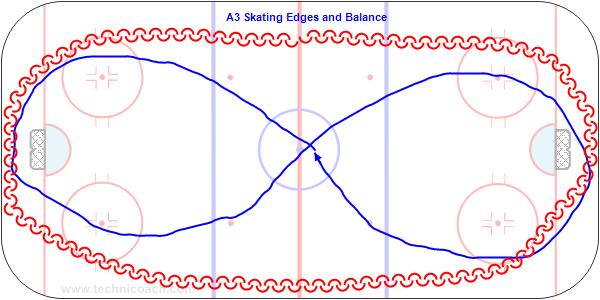
—————————————————————————–A3 – Skating Edges and Balance Warm-up – Kazakstan W
Key Points:
Skate forward, backward, pivot, Good to just go around when backward. Full speed 8's can be dangerous. A guy I play with collided with his best friend doing the big 8 and his friend died as a result of hitting his head on the ice.Description:
1. Player lead or the coach call out the technique.
2. Skate forward and backward.
3. Striding, crossovers, transition forward to backward, backward to forward.
4. Side to side smooth transition.https://www.hockeycoachingabcs.com/videos/watch/a3-skating-warm-up-kazakstan-w/
A3 Skating Warm-up Kazakhstan W

Attachments
'The Game is the Greatest Coach'
'Enjoy the Game'September 14, 2012 at 2:00 pm #6589KeymasterDT4 – Each Team Pass to Joker at Point – U18 F
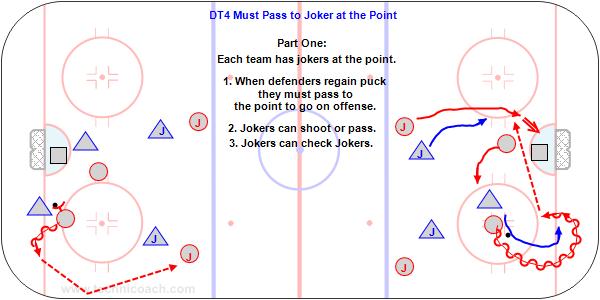
We did this one zone transition game and started with the rule that each team must have two jokers play the point. Before you could score you have to pass to the point. The jokers could check the opposition joker. We progressed to the rule that all goals had to come from point plays. This really caused the jokers to move so they could get the shot or shot pass through.
Key Points
Each team has one or two jokers at the point. Introduce the game allowing jokers to check jokers. This is a great game to practice getting the shot through under pressure.
The jokers at the point must get open and take a shot or make a pass. The defender practices covering the point. Low players get open and defenders cover man to man.Description:
Each team has one or two jokers at the point.
1. When defenders regain puck they must pass to the point to go on offense.
2. Jokers can shoot or pass.
3. Jokers can check the opponents Joker.https://www.hockeycoachingabcs.com/videos/watch/dt4-must-pass-to-joker-at-the-point/

Attachments
'The Game is the Greatest Coach'
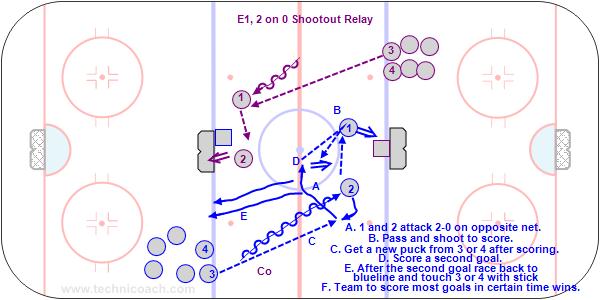
'Enjoy the Game'September 15, 2012 at 2:30 pm #6592KeymasterThis is the same setup as another 2-0 shootout game. The difference is there are no whistles but instead it is a timed relay race. Count the number of goals in a certain time. Last night we counted the goals in 5 minutes. We had 3 goalies so they got a break. Two goalies it might be a 3 minute game. Also limit the passes to one or two before shooting. One is more game like.
——————————————————————————————–
E1 Two Goal Relay Race – U18 FKey Points:
Work on shooting one timers and scoring on rebounds. Good habits like face the puck, give a target with the stick on the ice. Limit of 2 passes before each shot.Description:
A. 1 and 2 attack 2-0 on opposite net.
B. Pass and shoot to score.
C. Get a new puck from 3 or 4 after scoring.
D. Score a second goal.
E. After the second goal race back to the blueline and touch 3 or 4 with stick on shin pad.
F. Team to score most goals in certain time wins.https://www.hockeycoachingabcs.com/videos/watch/e1-two-goal-relay-race/
This is the same race but done across ice instead of the nets on the blue lines. Benefit is that the puck stays in play on wide shots.
https://www.hockeycoachingabcs.com/videos/watch/e1-2-0-shootout-relay-race/

Attachments
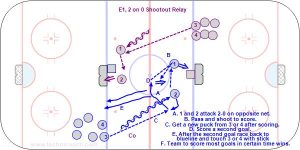
- E1 Two Goal Relay Race – U18 F.pdf (137 KB)
'The Game is the Greatest Coach'
'Enjoy the Game'September 21, 2012 at 3:08 pm #6604KeymasterA400 – Four Lane Circuit – One Youth and Four Pro Examples
Key Points:
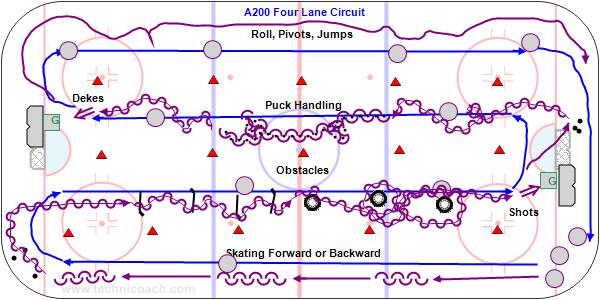
Practice skills down the lanes. Incorporate passes, shots, moves, dekes, obstacles, different pivots, jumps, multiple pucks, balls etc. This is a Howie Meeker circuit and is a great way to practice skills with large groups and use the ice efficiently.Description:
1. Set up four lanes up and down the rink.
2. Each lane has a different task.
3. Each lane could have a shot at the end.
4. Ideal for skills or for a Mission Impossible Game. (any level can play Mission Impossible)Youth
https://www.hockeycoachingabcs.com/videos/watch/a200-four-lane-circuit/https://www.facebook.com/tom.molloy.5836/videos/10159772978925931
A4 – Skating Skills 4 Lanes – Pro

A400 – Puck Handling Skills 4 Lanes – Pro

A400 – Skills in 4 Lanes – Pro

A400 Skating and Puck Handle 4 Lanes – Pro
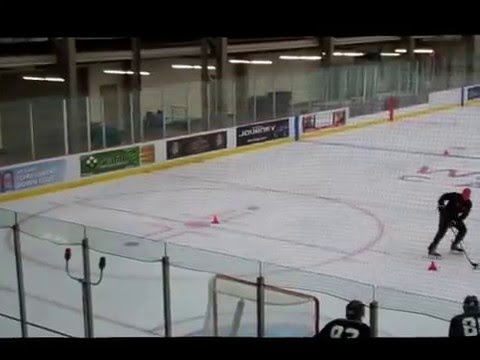
A400 – Skating Agility and Skills Circuit – Pro

Mission Impossible:
Mission Impossible was the most popular activity I ran in schools. The pictures are from a Kindergarten to ninth grade school, 5-14 year olds. All classes did it. We set up an obstacle course with the equipment in the gym. The kid's got 8 minutes to get to the end. Any failure and they have to start again. There was complete silence because the scenario was that they are trying to escape from a prison of war camp. Half the students were guards and half prisoners. If they touched the floor anywhere but safe places, knocked anything over, made a loud noise, were touched by a snake (dangling ropes), fell off the raft and into the acid moat (off the scooter and touch the floor) etc. They had to ring the bell at the top of the rope to finish. I built in areas where cooperation was needed to pass through.
At noon they all played together and there are pics with them in the regular clothes.
This same idea idea can be used at hockey practice by making a progressively more difficult circuit requiring individual or partner work.
https://skydrive.live.com/redir?resid=BD6FA116988317E9!1117&authkey=!qGy3MEUv!HE%24
Attachments
'The Game is the Greatest Coach'
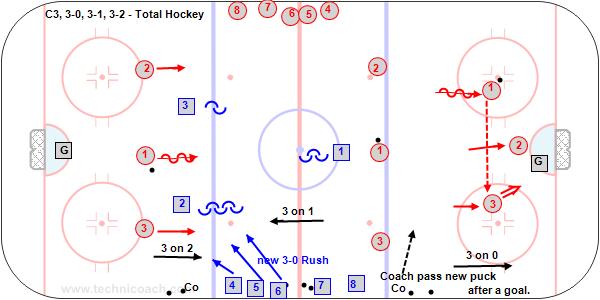
'Enjoy the Game'September 22, 2012 at 5:06 pm #6606KeymasterThis is a really good drill for pace and lines working together. It also is an opportunity to coach the offensive and defensive principles of each situation. If the F are lined on one side and the D on the other the coach can talk to them as they return to the line and not stop the drill unless it has totally gone south. Make it an ongoing contest and do it once a week or so.
————————————————————————————————————–
C3 – 3-0 – 3-1 – 3-2 Contest – U18 FKey Points:
Forwards create 2-1 situations with close support and speed. One player always hard to the net on a middle drive on a shooting play and a wide drive if they are open. Headman the puck and move through the neutral zone quickly and make the first pass in the offensive zone early.
Defenders must talk and identify coverage. Protect the middle of the ice and only play the puck carrier if he is vulnerable. Give the shot from the outside. Jam the trailer with legs in the shooting lane and stick in the passing lane. It is critical to have tight gaps and not just back in.Description:
Players are lined up along the boards in the C3 formation. Have 2 colours of jerseys and play one team vs the other if you have enough players. You can have D on one side and F on the other or they can wait on the side they will be playing.1. Three forwards take a puck and attack 3-0. The attack is over when the puck is over the goal line. (unless the coach wants a cycle and a shot).
2. Use the same puck and go the other way attacking 3-1 vs a D from the other colour (coach puts in a new puck if there is a goal).
3. Attack 3-2 in the original direction.
4. Three F from the other coloured team attack 3-0 on the vacant end.
5. Repeat sequence.
6. Coach count how many goals the team scores in 6 min. (or another time.
7. Keep a record of how many goals were scored.
8. F can score on rebounds above the goal line.
9. Next time if the F’s score less goals the G and D win and if they score more goals the F win.This example is Total Hockey where all the players play both forward and defense. This prepares the D to know what to do on the attack and F to be able to defend when they cover the point or are the first F back on the rush.
https://www.hockeycoachingabcs.com/videos/watch/c3-3-0-3-1-3-2-contest/
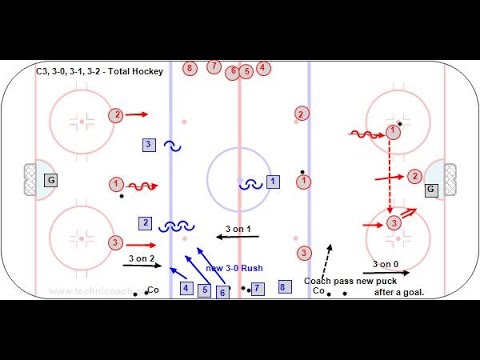
https://www.facebook.com/tom.molloy.5836/videos/10159773025720931
Attachments
'The Game is the Greatest Coach'
'Enjoy the Game'September 24, 2012 at 3:28 pm #6608KeymasterA6 – Puckhandle and Shot – U22 W
Key Points:
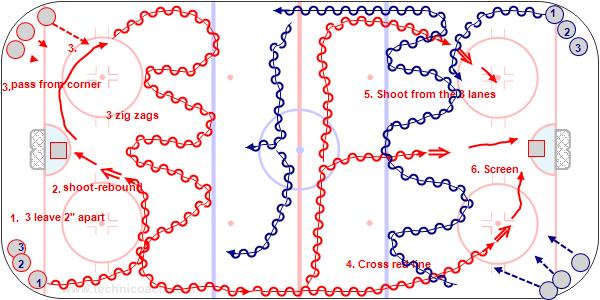
Players should do many moves down the ice and learn to shoot while skating and then follow the shot for a rebound. Work on loosening the shoulders and the ability to handle the puck with big moves all around the body.
Description:
1. Players line up in diagonal corners.
2. Leave and do various puck handling moves down the ice.
3. Next player leave about 3" later so the line up keeps moving.
4. Shoot and follow the shot.
5. Circle back and rebound for the next shooter.https://www.hockeycoachingabcs.com/videos/watch/a300-puckhandle-and-shot-u22/

Attachments
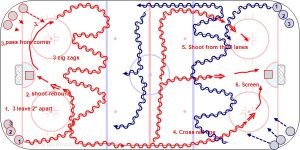
- A6 – Puckhandle and Shot – U22 W.pdf (169 KB)
'The Game is the Greatest Coach'
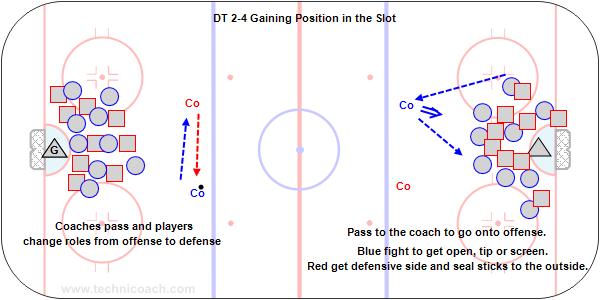
'Enjoy the Game'September 25, 2012 at 7:38 pm #6611KeymasterT2-4 – DT4 – Gaining Position in the Slot or BATTLE IN THE WAR ZONE – U18 F
This is a slot drill then game we will do tonight at practice. Just thought of it and we need to control sticks in the slot and not just be there .I took a video of the second part where the defenders pass to the coach at the point who can pass or shoot while the players fight to take or protect their stick. I think the players got the idea of how to seal sticks to the outside and find and opponent in the slot on defense and get open and keep the stick free on offense. It looks chaotic but when you play in the WAR ZONE it is chaotic.
Key Points:
Offensive players fight for offensive side and to keep their stick free and defensive players fight for defensive side and to control the attackers sticks.Description:
1. All players are in front of the net in two colours.
2. Start with the coach calling red offense and they try to get open and the blue cover them and control their stick.
3. Progress to 2 coaches at the point. One on each team. When they pass the players change roles o to d and d to o.
4. Play a game where the defenders must pass to their coach at the point to be on offense.
5. Offensive coach can shoot or pass.
5. Everyone stays within the dots and below the top of the circles.https://www.hockeycoachingabcs.com/videos/watch/dt-2-4-take-sticks-pass-to-point-on-transition/

https://www.facebook.com/518555930/videos/pcb.798067511103048/10159773122025931
We played this Battling Game after it is a DT4 (transition Game in one zone) game with each team having one of two jokers at the point. Jokers cover jokers and defenders must pass to the point to go onto offense. The point player then has to BATTLE to get the puck through with a pass or shot while teammates battle for position and give support. I have posted a video from the same practice to show how one technique game is reinforced by a SAG transition game.
DT4 – Jokers at Point and Below Goal Line-Jokers Check – U18 F

Attachments
'The Game is the Greatest Coach'
'Enjoy the Game'September 26, 2012 at 1:50 pm #6613KeymasterD – Games to Learn to Play – D2 – D6 Variations – Youth
Key Points:
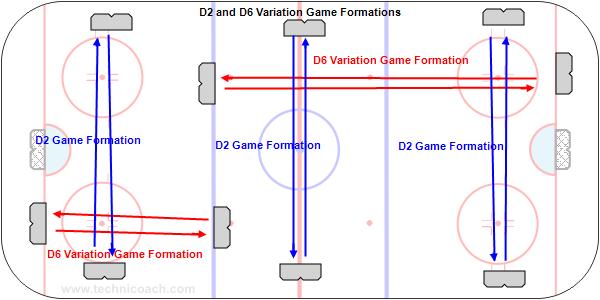
This is an example of how to use multiple nets with groups that have mixed ability levels. In this ice session we had 3 cross ice games and then moved the net for one 2/3 ice and one 1/3 ice game happening at the same time. There were 3 different modified games and each had a purpose.Description:
Game One: D2 – cross ice game with the rules there must be at least 2 passes but you have to beat a defender before passing.Game Two – cross ice game D2 – Only 1 pass Allowed Receiver must score.
Game Three – D6 Variation 2 – Two Passes and All Must Score before you can score a second goal.
Game one encourages passing and getting open but in order to beat a defender you must skate away from them to open ice. This is the most important habit a player can have when they get the puck.
Game Two allows one pass, so a fake pass is an effective move. Theme of the practice is stickhandling and the pass receiver must make moves, dekes and protect the puck in order to score.
Game Three passing rule causes passing, getting open, covering away from the puck to happen. All must score forces everyone to participate hard and get open so they can score. It also requires the players to get their head up and do things like screen away from the puck.
I was taking the video so no coach was enforcing the rules in two of the games. The older players are used to modified rules and were doing them. The beginner group has more trouble because they are struggling with the basic skating and puck handling but it is good to teach them how to play at the same time.
So rules must be enforced to be effective.
Here is a video of the three games.

Attachments
'The Game is the Greatest Coach'
'Enjoy the Game'September 27, 2012 at 2:27 pm #6614KeymasterT – Principles for Efficient Use of the Ice
I go from rink to rink to run practices, play myself and coach my hockey class and see many practices before and after mine. I also sometimes go and watch elite teams practice.
The game has changed since the last NHL strike-lockout-whatever (a regular occurrence now). Here are some of the main changes.
– no more can opener, you have to be able to skate backward, transtion skate.
– teams now back pressure the puck carrier, many all the way to the net. Creates a defensive 2-1 and now that F must be able to play the low 3-3 in the zone.
– attack with 4 players – one D joins the attack and 2 F go to the net creating a low and higher triangle. This demands hard back checking and picking up the 3rd 4th and 5th attackers.
– outnumbering in the corners – when the attackers back is to the play 4 defenders will be there and the weak side F having net coverage. Demands terrific puck protection skills and defensive awareness.
– more teams pinch on the strong side and everyone pinches on the wide rim. A forward fills behind the D and will have to play the defensive 1-1.
– hooking is now called so you have to defend from the defensive side and not reel the attacker in at the end of your stick.Given these changes I don't understand why the D would wear Black practice jerseys and take all of the defensive 1-1's and only do the passing on breakouts and not be joining in all rushes.
Transition games have been around for a long time and Erkka Westerlund wrote a booklet for HC with a video but I seldom see a transition game in practice. Still the OLD FASHION 1 on 1 with the F's attacking and the D's defending.
I watched an elite team practice yesterday in this 90's style method but I know the system they use wants the D to join the attack and they pinch on the strong side.
So I am saying that the practice methods should be changing along with the way the game is changing. Hockey is going more and more to 'Total Hockey' which is based on 1-2-3-4-5 Read-Recognize-Respond.
In Total Hockey all of the players have to develop ALL of the SKILLS. Everyone needs to be able to skate well both forward and backward. Everyone must be able to attack and defend in all situations from a 1-1 to a 5-5.
Now being designated as a Wing, Centre, Defenseman is simply stating the 'Home Position' where you start on the faceoff. A player is designated there because most of the time he/she will need those skills but at any time in any shift the defenseman #4 may end up being attacker #2 and should recognize that and have to skills and knowledge to play that situation effectively.
How should we change the way we practice.
1. Wear only two colours during practice with half the F and half the D and one goalie each colour.
2. Design the drills so that everyone attacks and defends for part of each practice.
3. Use drills to isolate technique and then turn them into transition games where after a 1-1 or 3-2 the defender must fight for rebounds and make a breakout pass.
4. Play many games that isolate specific skills and that everyone does.Two Suggestions for Better Use of Ice Time
A – coaches don't move pucks – players simply put the pucks where they are needed next when one activity finishes.
B – only go to the board for new activities. Even many new activities can start with a simple explanation. (this whiteboard stuff started in the 80's, before that the coach simply told the players where to start, what to do and had a few of the smarter ones demonstrate) Once you have done something name it and give a 30 second reminder and get keep the practice moving – simply add tasks on the go i.e. extra passes, extra players, dump-ins.Moving 7-12 minutes per hour is just not acceptable.
Where these coaching ideas come from.
I have been lucky enough to coach with many elite coaches, meaning Olympics, NHL, University, Pro and Minor Hockey and attended seminars or had lengthy discussions about the game. This is where I get these ideas. I also attend an international seminar almost every year to stay up with the game.
I taught PE for 34 years at almost every level. Elementary, Junior High, High School, College. About 25 000 classes where I experimented with these ideas.
I have coached at almost every level over the last 45 years. All ages of minor hockey, camps in seven countries on three continents, elite girls and boys hockey, university men, college men and women, (13 men and 9 women's teams at all 3 Calgary institutions with teams), international and women's pro,
So I have had a unique opportunity to coach with and watch and listen to many of the best coaches on the planet. The point of this website and the Facebook coaching site is to share these ideas.
Juhani Wahlsten – Finland legend. Worked with Juuso starting 1985.
Coach Peters at Bemidji who defined 'Who we are.' and that consistent message resonated in everything we did.Vladimir Jursinov – Russian Olympic coach. Did seminars with Jursi and Juuso and coached with Jursi in Salzburg.
Reijo Ruotsalainen – Coached with Rexi in Salzburg.
Gene Reilly – Salzburg – Gene now coaches in Russia.
Willy Desjardins – NHL, Olympics -six seasons as assistant coach for Willy at U of Calgary.
Mike Johnston – NHL Olympics – coached against Mike 3 years and with him at U of C.
Terry Johnston – NHL D – coached with TJ at u of C and minor teams. Best D coach I have worked with.
Pierre Page – NHL – Salzburg HC
Mike Kennedy – NHL F – co-coached at SAIT with Mike. Author of 'Make Hockey Great Again' Now coaches in Japan.
Mike Tschumi – European Pro – 3 of his players were in the U20 World tournament this year. We coach together now.
Brent Devost – HC of men's team at SAIT. Runs really good practices and team building. I was assistant.
Jim Molloy – great with skills and team building.
Slava Lener – assistant coaches together one season at U of C. Head of Czech hockey and Olympic coach.
Tim Bothwell – NHL D – Olympic W – HC at U of C two years while I assisted.
Wally Kozak – Olympic W coach – Men's National Team – Wally and I coach together a lot.
Dr. Gaston Schaeffer – international skating coach.
Court Dunn – coaches school hockey and an expert at using 'games to teach the game.'
Deniz Ince – coach of Turkey who is a student of the game.
Lots of discussion with great coaches like Erkka Westerlund, Petr Svoboda, Curtis Brackenbury, Mike Hartman.
Lots of others not mentioned here.
Attachments
'The Game is the Greatest Coach'
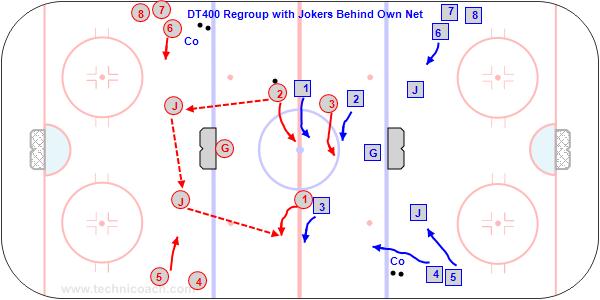
'Enjoy the Game'September 27, 2012 at 3:31 pm #6615KeymasterDT400 – Regroup with Jokers Behind Defensive Net – CW
Key Points:
Practice regroups and breakout options. Jokers can pass right away or go D to D, switch, counter etc.Description:
1. Place the nets on the opposite blue lines.
2. Play from 1-1 to 5-5.
3. Each team has 1 or 2 jokers behind their goal line.
4. Defensive team transitions to offense by passing to a joker.
5. Jokers can pass to each other, switch, drive the back of the net etc.
6. Play about 30" then switch with jokers playing, waiting players become jokers 5 and 6) and active players (1-2-3) rest.
Options: After the players learn the basic game add good habits like they must move with the puck, or saucer snap passes, pivots etc. (you don’t want them standing still while passing) They could even join the rush and then return on loss of possession.https://www.hockeycoachingabcs.com/videos/watch/dt400-regroup-with-jokers-behind-defensive-net-cw/

https://www.facebook.com/518555930/videos/pcb.798610214382111/10159775476895931
Attachments
'The Game is the Greatest Coach'
'Enjoy the Game'September 27, 2012 at 3:57 pm #6616KeymasterA2 Russian Puck-Handling Warm-up with Shots
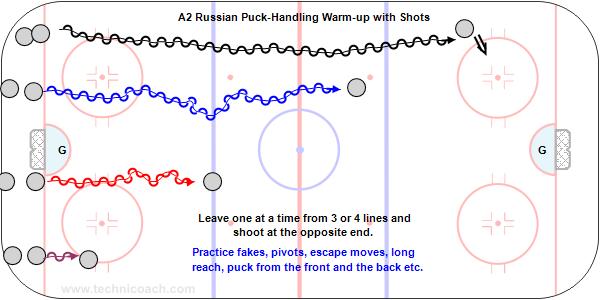
I am reposting this Puck Handling drill that Vladimir Jursinov uses to teach moves and then finish with a shot. There was no video link, pdf or diagram the last time I posted it. It is a great way to teach and practice moves and warm up the goalies. I have the players stagger on the start so the goalie has a little more time to get set for the next shot.
Jursi is a great guy. I was helping him with English when we coached together in Austria and last saw him in May at the IIHF coaching symposium.
—————————————Key Points:
This can be done every time players go on the ice to expand their muscle memory. The point of these exercises is to increase the size of the reach with the stickhandling moves, and to separate the upper and lower body.
This is one of the most important exercises a player can do to develop puck handling skills. All the moves can also be practice off ice with various kinds of balls and pucks.Description:
• From the A2 formation, players skate down the ice in 3 or 4 groups; practice big moves with the puck. One player leave and the next player go when he/she gets past the top of the circle. Finish with a shot from your lane no closer than the hash marks.
. Go one way then the other and do a different skill each time.
• Reach forward while down on 1 knee, reach back as far as you can.
• Give the puck forward and take it back with the toe of the stick.
• Place hands close together and reach sideways each way as far as possible.
• Practice head fakes and shoulder drops, and move the puck quickly to the other side of your body.
• Do high step-overs, when you step with your right foot to the left, reach as far as possible to the right with the puck, step with the left foot to the right and reach as far as possible to the left with the puck.
• Reach back as far as you can with the puck, turning the upper body so you are looking behind you as you skate in the opposite direction. Do the same the other way.
• Do 3 or 4 crossovers to the left and reach as far as possible to the right with the puck, then cross over to the right and reach as far as possible to the left with the puck. Reach back as far as you can with the puck, turning the upper body so you are looking behind you as you skate in the opposite direction.
• Single fake by practicing a small fake one way, then quickly pull the puck across your body to the other side.
• Double fake by giving a small fake one way, then quickly pull the puck across your body to the other side. Immediately bring it back.
• Put the puck behind you and pass it up into your skates from 1 side, then the other.
• Have the puck in front of you and pass it back to your skates and up to your stick, then off the outside of each skate and to your stick.
• Reach back on the forehand, then quickly pull the puck across your body.
• Skate backwards with the puck after pivoting to the right and do the same after pivoting left.
• Slide sideways, pushing about 4 or 5 times with the inside skate and gliding on the outside skate. Fake passes and shots while skating like this.
• Pivot a complete circle to the left and then to the right.
. Fake a slapshot and go around opponent on the backhand side.
. Fake a slapshot and go around opponent on the forehand side.
. Fake a slapshot and then do a backhand tight turn around opponent.
. Fake a slapshot and reach out like you are going around the opponent on your forehand and then pull the puck quickly to your backhand and go around opponent.
Any move can be practiced in this method.https://www.hockeycoachingabcs.com/videos/watch/a200-russian-puck-handling-warm-up-with-shots-with-vladimir-yursinov/
(Vladimir Jursinov)
Attachments
'The Game is the Greatest Coach'
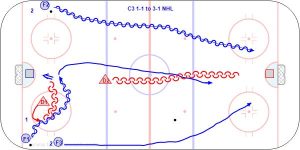
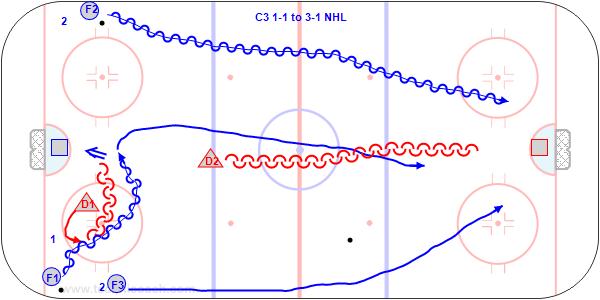
'Enjoy the Game'September 28, 2012 at 3:04 pm #6618KeymasterC3 – 1-1 to 3-1 – Pro
Key Points:
Maintain defensive side on the 1-1. Attack with speed on the 3-1 making the first play early while the defender delays the play from the middle.Description:
1. Start with a forward walking out of the corner and attacking vs. one defender.
2. When 1-1 is finished two new attackers start up the ice vs. one defender.
3. The original forward join the attack and the D follow making it a 4-1.Option: To make it more gamelike the original attacker could backcheck while the D joins the play
https://www.hockeycoachingabcs.com/videos/watch/c3-1-1-to-3-1-nhl/

Attachments
- C3 – 1-1 to 3-1 – Pro.pdf (172 KB)
'The Game is the Greatest Coach'
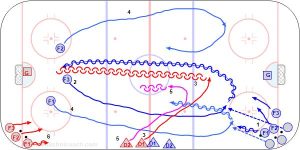
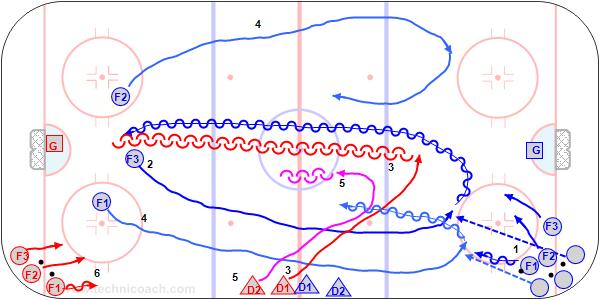
'Enjoy the Game'October 1, 2012 at 2:41 pm #6619KeymasterC2 – 3-0 – 1-1 – 2-1 – Pro
Key Points:
Forwards should attack with speed and defense play a tight gap.Description:
1. Start with a 3-0 attack from one corner. All attacks are on the same net.
2. F3 skate back and get a puck from the original end.
3. D1 leave line and defend a 1-1 vs. F3.
4. F1 and F2 come back for another puck.
5. D2 defend a 2-1 vs. F1 and F2.
6. Repeat from the other end.https://www.hockeycoachingabcs.com/videos/watch/c2-3-0-1-1-2-1-pro/

https://www.facebook.com/518555930/videos/pcb.798628891046910/10159775589825931
Attachments
- C2 – 3-0 – 1-1 – 2-1 – Pro.pdf (71 KB)
'The Game is the Greatest Coach'
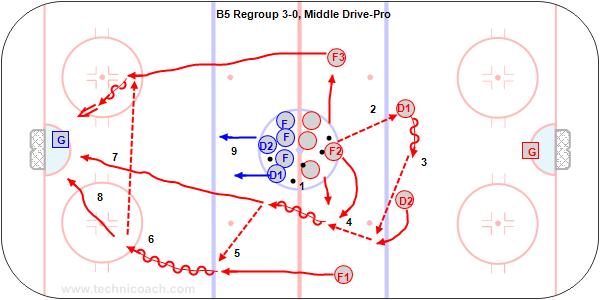
'Enjoy the Game'October 2, 2012 at 2:13 pm #6620KeymasterB4 – Regroup 3-0 – Middle Drive – Pro
Key Points:
Defense move quickly and hinge the pass up the middle. Pass hard. Centre give the stick and skates as a flat target. Middle drive hard to the net.Description:
1. All the players are inside the middle circle.
2. Red D1get a pass from a Red F2.
3. Red D hinge and pass D1 to D2.
4. D2 pass to F2 supporting in the middle.
5. F2 pass to F1 on the strong side.
6. F1 gain blueline and pass wide to F3.
7. F2 middle drive skating hard to the net.
8. F3 shoot and all crash the net for a rebound.
9. Blue repeat in the other direction.https://www.hockeycoachingabcs.com/videos/watch/b5-regroup-3-0-middle-drive-pro/
B5 – Regroup 3-0 – Middle Drive – Pro

https://www.facebook.com/518555930/videos/pcb.799207697655696/10159777877555931
Attachments
'The Game is the Greatest Coach'
'Enjoy the Game' -
AuthorPosts
- You must be logged in to reply to this topic.