Home › Forums › Talk Hockey › Daily Drill Section Eleven
- This topic has 157 replies, 2 voices, and was last updated 2 years, 3 months ago by
Tom Molloy.
-
AuthorPosts
-
October 3, 2012 at 3:24 pm #6622
Tom Molloy
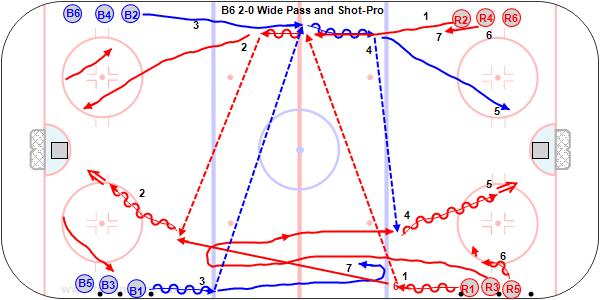
KeymasterB6 2-0 Wide Pass and Shot – Prospects
Key Points:
Pass hard in front of receiver so he doesn't have to slow up. Keep the stick blade square to the puck. Keep the stick in front when shooting in the triple threat position.Description:
1. Start off with R1 passing wide to R2 and R3 follow
2. R2 passes back to R1 who shoots.
3. Change directions with B1 across to B2 and follow.
4. B2 skates and passes to R3 who turned at the blueline.
5. R3 shoots and B2 rebounds.
6. R5 leaves and passes to R4 and follows.
7. R4 pass to B1.
8. Continue this flow in each direction.https://www.hockeycoachingabcs.com/videos/watch/b6-2-0-wide-pass-and-shot-pro/

Attachments
'The Game is the Greatest Coach'
'Enjoy the Game'October 5, 2012 at 1:02 pm #6628RookieCoach
Guest3 Player Breakout with High/Cycle
This drill works on small parts of the big picture. Works on different passing options for a breakout.(wall, middle lane, touch backs).
Stress positioning for Middle lane support. I like this position no higher than the winger on the breakout for support on a turnover.Description
Drill starts on whistle and done on both sides .
1- Coach spots a puck in corner.
2- D 's skate backwards pivot shoulder check and pick up puck.
3- F1's take board side pass option.
4- F2's Take middle lane pass option and support .
5- F'1 and F2 skate down ice passing the puck for a shot on net.
6- Shooter holds the net front for screens , rebounds etc. Passer picks up a puck in the corner and skates high circle and cycles high with D1.
7 – D1 reads the play communicates with F for the high cycle.
8- D returns pass to F for a second shot on net.Options- Low cycle with pass back to D1 for point shot
Attachments
- 3 Player BreakoutHigh-Cycle (1).pdf (106 KB)
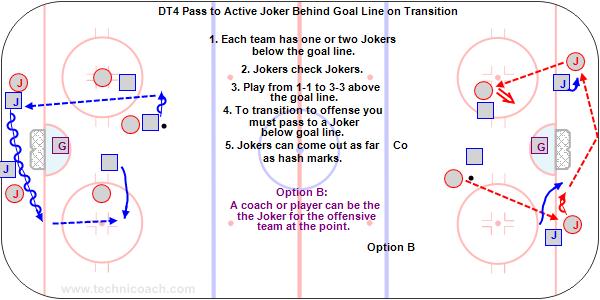
October 5, 2012 at 2:47 pm #6629KeymasterDT4 – Pass to Active Joker Below Goal Line on Transition – U18 F
Key Points:
Jokers battle behind the net to get open and make plays. Use cut backs and protect the puck with the body. This game is a SAG below the goal line and requires good technique.Description:
1. Each team has one or two Jokers below the goal line.
2. Jokers check Jokers.
3. Play from 1-1 to 3-3 above the goal line.
4. To transition to offense you must pass to a Joker below goal line.
5. Jokers can come out as far as hash marks.Option B:
A coach or player can be the Joker for the offensive team at the point.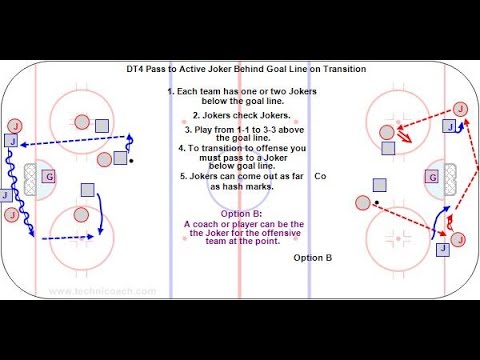
https://www.facebook.com/518555930/videos/pcb.799239824319150/10159778011695931
Attachments
'The Game is the Greatest Coach'
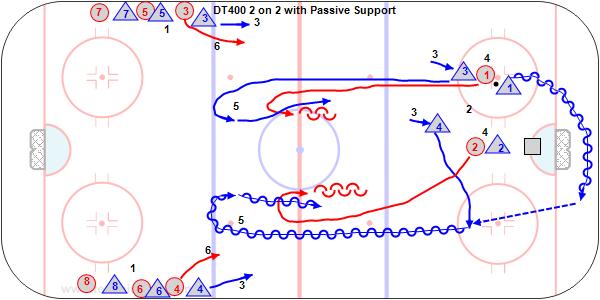
'Enjoy the Game'October 6, 2012 at 2:55 pm #6630KeymasterDT400 – 2 on 2 with Passive Support – College W
Key Points:
Supporting players follow the play and position themselves as if they were covering the point and then getting open for a breakout pass. It is important that the new defenders follow the play up the ice and close the gap in the neutral zone.Description:
1. Players line up behind the blue lines on each side.
2. Offensive 1 and 2 go vs defenders 1 and 2
3. Defenders 3 and 4 follow the play into the zone and support as wingers would.
4. Offensive 1 and 2 must attack quickly.
5. After a goal, frozen puck or breakout pass 3 and 4 skate to the far blue line, turn to attack the original offensive 1 and 2.
6. Two players leave to support the defending team.
7. Continue this flow.DT400 – 2-2 Defenders Get Support – College W

This transition game is an example of how to coach 'Total Hockey' where all the players learn to play forward and defense. Everyone gets reps attacking and defending various situations. You can only play 'Total Hockey' if you develop Total Hockey Players". If you do this then they are capable of playing any sytem and leave your team with a well rounded 'Skill Set' that will enable them to play all over the ice in all situations. If you dress your defense in a different colour and have them take all of the defensive 1-1's, 2-1's etc. they won't develop offensively like they could and the forwards will also have limited defensive skills. So all players must learn to skate forward and backward, do transition turns, know how to break out whether they are 1-2-3-4 or 5 in any zone.
This is a big challenge for coaches to run practices that develop COMPLETE PLAYERS.
Another challenge in developing complete players is to have playing systems (forecheck, dzone, PP) that are based on the Three R's: Read-Recognize-React. We have to develop the HARD SKILLS (what, how) of good technique in shooting, passing, puck handling, skating, pass receiving with lots of reps in practice with perfect technique. We also have to develop the SOFT SKILLS of creativity, reading the game, (where, when, why) using free flow situations such as full and small area games.
BIG CHALLENGE but we wouldn't coach if it was easy.
Daniel Coyle talks about how to develop the hard and soft skills and the Three R's in his new book "The Little Book of Talent"https://www.hockeycoachingabcs.com/videos/watch/dt400-2-on-2-with-passive-support/
https://www.facebook.com/518555930/videos/pcb.799246270985172/10159778044000931
Attachments
'The Game is the Greatest Coach'
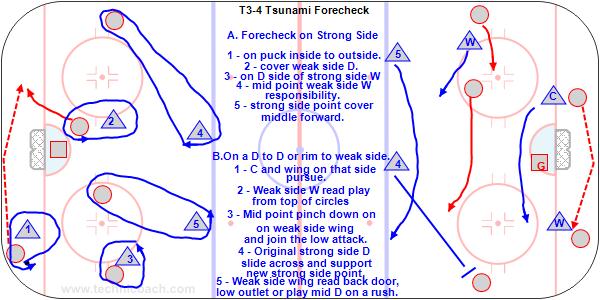
'Enjoy the Game'October 10, 2012 at 3:11 pm #6641KeymasterT3-4 – Tsunami Forecheck
Key Point:
Attack with 4 players and create constant pressure on the puck.Description:
In the 'Tsunami' forecheck when the D pinches on the weak side they stay in and forecheck on that side and work the triangle. When the puck goes to the other side they return to the point. We want the wing to stay on their side when the puck is moved to the other side and play high slot ready to play the mid- point if they get possession or jump down back door or to the corner if the puck comes around. They are responsible for the weak side on the rush. So if the puck starts on the left side and moves to the right side then the RW and C and RD will be low. If the RW was 3 on the original attack then stay on that side and switch with the LW and play the high slot. So whichever wing was 3 become the mid-fielder. C go to the side the puck is on.The LD will have slid over to cover the point and the LW will be at the top of the circle. So it is like a high umbrella. If the puck is moved back to the left side the three forwards attack from there. The LD is back on the left point and RD on the right point. So once the original penetration is made and the puck moved to the other side it is basically man on man responsibility until the puck leaves the zone.
It is like having the Pounce on both sides. The Pounce has only the RD pinching and the LW as a midfielder. The Tsunami has both D pinching when the puck is moved to the weak side and the wing on the original side becomes a midfielder ready to go back, support a weak side pass or attack back door. When it is 50-50 whether we will gain the puck or not they have to fall back and play middle D. So when we have possession there are 4 on the attack.
After using the Tsunami there are some improvements that can be made to get the D more involved in the offense and use the forward who is covering the middle point from the top of the circles ready to go back or to be an offensive option either going for a back door back door pass or pass behind to move the puck to the other side. I also want the C to go to the strong side and usually the wing to stay on their side but if they were 3 and covering the strong side W then stay on that side as the midfielder and switch with the other wing.Diagram Description:
Key Points:
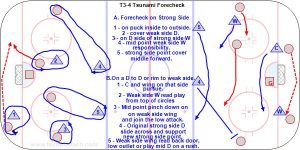
The start of the forecheck is 1-2-3-4-5 and when the puck moves to the other side on a D to D or rim a wing stays on that side and becomes a midfielder and the C and Wing who's side it is moved to skate there and attack with 4 who has pinched wide.Description:
A.
1 – on puck inside to outside.
2 – cover weak side D.
3 – on D side of strong side W.
4 – mid-point weak side W responsibility.
5 – strong side point cover middle forward.B.
On a D to D or rim to weak side.
1 – C and Wing on that side pursue. If the weak side wing was 3 on the original forecheck then they switch with the other wing and stay on the weak side when puck is moved to the other side.
2 – Weak side W read play from top of circles
3 – Mid-point pinch down on weak side wing and join the low attack.
4 – Original strong side D slide across and support new strong side point.
5 – Weak side wing read back door, low outlet or play mid D on a rush.TO SIMPLIFY THE EXPLANATION – WHEN THE RD PINCHES ON A RIM OR D TO D THE LW COVERS THE WEAK SIDE POINT. (if the puck rotates again then the 2 D are back on the points) So if the attack starts on the right side and they pass D to D or rim and the LD pinches then the RD covers the middle point.
Attachments
- T3-4 Tsunami Forecheck.pdf (380 KB)
'The Game is the Greatest Coach'
'Enjoy the Game'October 12, 2012 at 1:54 pm #6650KeymasterThe most difficult things to coach are the Soft Skills of getting open, feeling pressure one way and quickly spinning the other way to open ice. This reading-recognizing-reacting is what determines how successful a player is during games. This feel for the game and good habits like facing the puck, giving a target, pass and immediately get open compliment the Hard Skills of passing, receiving and skating. This is a great game to practice these hard skills, soft skills and good habits.
——————————————————————————————–
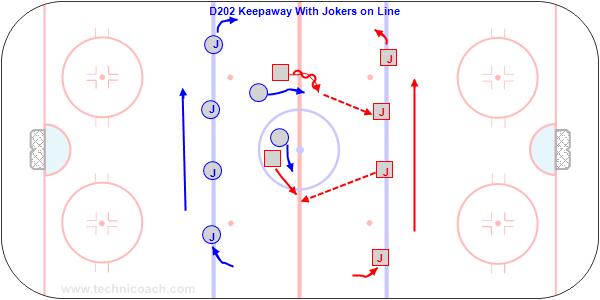
D202 – Keep-away With Jokers on Line 1-1 to 3-3 – U18 FKey Points:
Protect the puck, use fakes and change the type of passes and the situation.
This is a great game to practice puck support, getting open, passing and puck protection.Description:
1. Active players are in the middle.
2. Jokers are lined up along the blue lines.
3. Passes to Jokers are allowed.
4. Play even situations up to 3-3.
5. Vary the situations 2-1, 3-1, 3-2.
6. On whistle leave from one end and return to the line-up at the other end.
* Award one point for making 5 consecutive passes and keep score.https://www.hockeycoachingabcs.com/videos/watch/d202-keep-away-with-jokers-on-line/

Attachments
'The Game is the Greatest Coach'
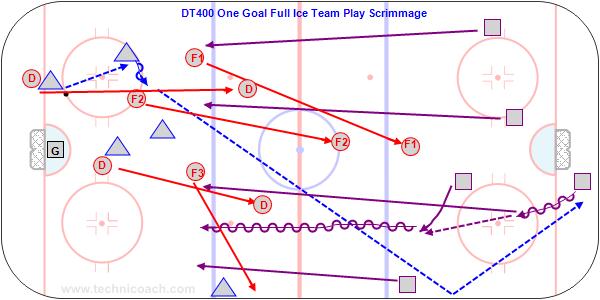
'Enjoy the Game'October 13, 2012 at 2:57 pm #6652KeymasterCoaching youth hockey is very different than coaching college or in a pro organization where you usuall have at least 20 skaters. It is difficult to practice full ice team play. You scrimmage but find the players get too tired and are always changing on the go. Many youth teams only have ONE goalies or if a goalie is missing there isn't a third one to fill in. I have used this rotation line where one unit rests at the far blue after defending. Yesterday instead of waiting at the far blueline we had them wait at the far end and set up for a breakout. The defending team shoots the puck down the ice and the team that just attacked now forechecks.
This adds the breakout and forecheck to the scrimmage. If the defenders gain the puck they dump it deep and skate back to touch the red line and forecheck again. If there are two goalies the passive one can set up the puck on the dump in and rotate.
I will make this a regular part of our pre game practices or team play teaching practices.
Nest time I will try to get a video now that the players understand the rotation.
—————————————————————————————–D1 – One Goal Full Ice Team Play Scrimmage – U18 F
Key Points:
Practice team play situations with 3 groups. It is best to have one colour for each group. The next group to attack waits at the far end.
Practice from 3-3 to 6-5 in a controlled scrimmage mode. Coach can give input while the players wait at the far end.Description:
1. Red circles attack vs. Blue triangles either even or odd situation. Extra blue on the side if it is on the pk.
2. On a goal, frozen puck or turnover the blue fires it to the other end and forechecks.
3. Purple breakout and attack vs. blue and the red sets up to breakout at the far end.
4. Continue this rotation of ATTACK-DEFEND-SET UP AT FAR END.
https://www.facebook.com/518555930/videos/pcb.799831560926643/10159780457880931
Attachments
'The Game is the Greatest Coach'
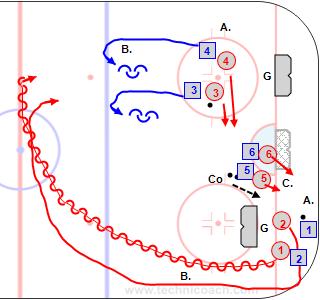
'Enjoy the Game'October 15, 2012 at 3:12 pm #6655KeymasterMy assistant coach Sean Kibyuk in charge of the defensemen designed this small area game using two nets. The game creates lots of battles and the players must transition from offense to defense and defense to offense.
———————————————————————
DT400 Kibyuk Small and Smaller Area Games at Once 1-1 to 3-3 – U18 FKey Points:
Set one net up on the goal line below the face-off dot facing up ice and the other net facing the corner just inside the circle. The game is continuous and thecoach shoot in a new puck on a goal.Description:
A. Blue 1 and 2 attack Red 1 and 2 in the corner and Blue 3 and 4 attack Red 3 and 4 from the red line.
B. Coach whistles and Red 1 and 2 carry the puck out to the red line and attack the other net vs. Blue 3 and 4.
C. Coach shoots in a new puck and Red 5 and 6 attack vs. Blue 1 and 2 in the corner. Red 3 and 4 return to the line.
Option: Vary the number of players from 1 to 3 and switch up who starts on offense half way through the game.https://www.hockeycoachingabcs.com/videos/watch/dt400-kibyuk-small-and-smaller-area-games-at-once/

https://www.facebook.com/518555930/videos/pcb.799842827592183/10159780485295931
Attachments
'The Game is the Greatest Coach'
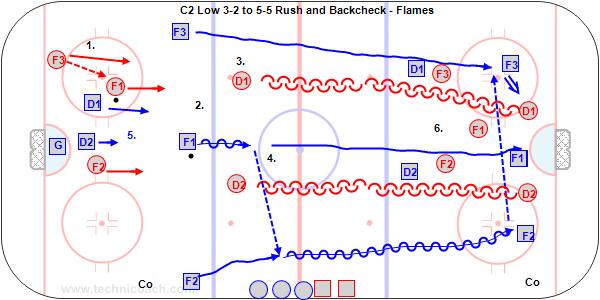
'Enjoy the Game'October 16, 2012 at 3:27 pm #6657KeymasterC2 – Low 3-2 to 5-5 Rush and Backcheck – Pro
Key Points:
Good way to practice low zone coverage, D joining the play and F's coming back into the zone. A good habit is to turn up ice and find your check when you see everyone in front of you is covered.Description:
1. Red F1-F2-F3 attack low vs. Blue D1-D2.
2. Blue F1-F2-F3 wait with a puck at the top of the circles. Extra players along the boards.
3. Red D1-D2 are ready to defend the 3-2 attack.
4. On whistle Blue F1-F2-F3 attack R D1-D2.
5. B D1-D2 join attack and R F1-F2-F3 backcheck.
6. Play 5 on 5.Alternative: Use one puck and defense pass to waiting forwards instead of 2 pucks and a whistle.
https://www.hockeycoachingabcs.com/videos/watch/c2-low-3-2-to-5-5-rush-and-backcheck-flames/

https://www.facebook.com/518555930/videos/pcb.799851697591296/10159780523065931
Attachments
'The Game is the Greatest Coach'
'Enjoy the Game'October 17, 2012 at 2:23 pm #6659KeymasterWe did this at practice yesterday and it worked really well. A benefit is that you practice the D joining the rush, the F backchecking and you play a 5-5 at each end but only need 8 F and 8 D. My assistant coach Sean Kibyuk ran this. I will get a video next time.
——————————————————————————–
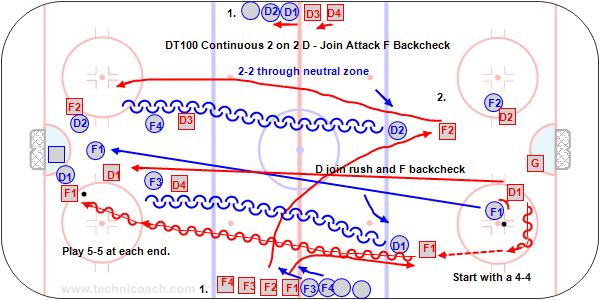
DT100 Continuous 2 on 2 D – Join Attack F Backcheck – U18 FKey Points:
Forwards cover D and D cover F's. One D should join the attack to create triangles and one forward backcheck. Play tight gaps and attackers create 2 on 1's on the rush. Play 5-5 at each end.Description:
1. Forwards line up on one side and defense on the other.
2. Start with a 2 on 2 attack Blue F1 and F2 vs Red D1 and D2.
3. When the puck enters the zone defensive Red F1 and F2 support Red D1 and D2 and Blue D1 and D2 support Blue F1 and F2.
4. On transition Red D1 join new attack and Blue F1 backcheck
5. If the puck is dumped out with no possession the offensive team regroup and attack again.
6. Red F1-F2-D1 now go 3 on 3 in the other direction vs. Blue D1-D2-F1.
7. Blue F2 – F3 support Blue D1-D2-F1 and Red D3 and D4 support attacking Red F1-F2-D1.
8. This rotation continues with a 5-5 in each zone.*Various numerical situations can be practiced with this flow. A 1-1 becomes a 3-3 at each end, a 2-1 becomes a 4-4.
https://www.hockeycoachingabcs.com/videos/watch/dt100-continuous-2-on-2-d-join-attack-f-backcheck/

https://www.facebook.com/518555930/videos/pcb.799864230923376/10159780572895931
Attachments
'The Game is the Greatest Coach'
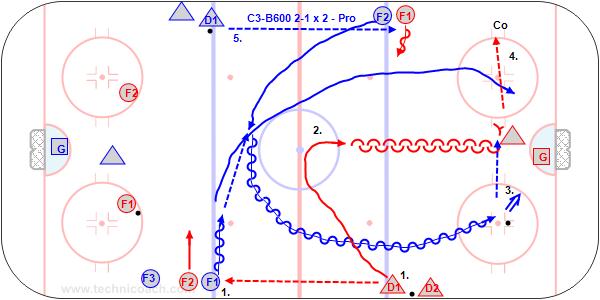
'Enjoy the Game'October 18, 2012 at 2:02 pm #6660KeymasterC600 – 2-1 x 2 – Pro
Key Points:
Offense should attack with speed and force the D to make a decison early by the first play near the blue line. This allows for a secon play. D should delay the attack as much as possible and defend the most dangerous player allowing a bad angle shot.Description:
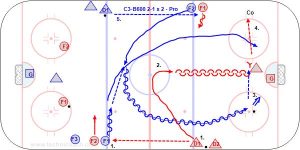
1. Red D1 pass to Blue F1.
2. Blue F1 and F2 cross in the neurtal zone and attack Red D1 2 on 1.
3. Blue F1 and F2 continue until they score or the goalie freezes the puck.
4. Red D1 defend and pass to the coach when they get the puck.
5. As soon as the puck enters the offensive zone Blue D1 Pass to Red F1 who attack in the other direction with Red F2 vs. Blue D1.https://www.hockeycoachingabcs.com/videos/watch/c3-b600-2-1-x-2-pro/

Attachments
- C600 – 2-1 x 2 – Pro.pdf (77 KB)
'The Game is the Greatest Coach'
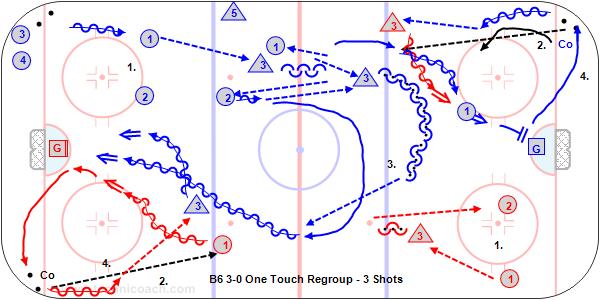
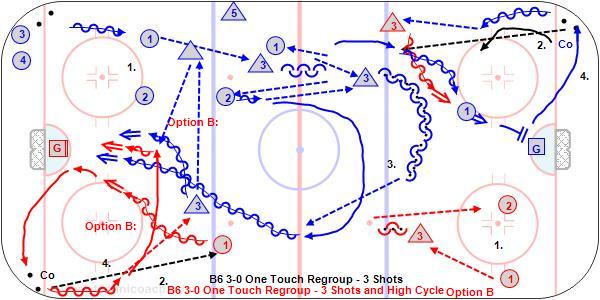
'Enjoy the Game'October 19, 2012 at 2:40 pm #6662KeymasterB6 3-0 – One Touch Regroup – 3 Shots – Pro
Key Points:
Face the puck and one touch two passes to start. Shoot while skating and follow the shot for a rebound. This is done out of diagonal corners at the same time.Description:
1. F1 and F2 leave from the corner and exchange the puck twice with the D1.
2. F1 continue and get a pass from coach in the corner shoots and screens.
3. D1 pivot and Pass to F2 who shoots and screens.
4. Red F1 cycle out of the corner and pass to Blue D1 who shoots from the point.https://www.hockeycoachingabcs.com/videos/watch/b6-3-0-one-touch-regroup-3-shots/

https://www.facebook.com/518555930/videos/pcb.800517707524695/10159782723395931
Attachments
'The Game is the Greatest Coach'
'Enjoy the Game'October 22, 2012 at 8:33 pm #6665KeymasterT2 – Kingston Power Play and Team Play Rotation – U18 F
I learned this when George Kingston came on the ice for one of our U of Calgary practices. He had left coaching at the U of C to start his NHL and international coaching career. I think it is a miracle working drill where you can practice the offensive options of the pplay or even strength situations along with a controlled breakout. I use this every practice before a weekend series. My teams usually are very good on the power play. We have 15 pp goals in the first 11 games and that has been the case since I started using this practice method. I combine it with requiring a shot every 3" that I picked up from Pierre Page when I was with the Red Bulls in Austria.
When you coach a long time you find that some things are real 'Keepers' and this is one of them.Key Points:
Practice options where every player gets a shot. Begin with a rotation attacking the seam between the D and the F and read what they give. If the D forces then the low play is available, if the F forces then the point is open. If the pk box is passive then there is a 2-1 at each corner, a 3-2 on each side and seams between players to attack. Force the pace by taking a shot by a different player every 3 seconds. Coach in each zone
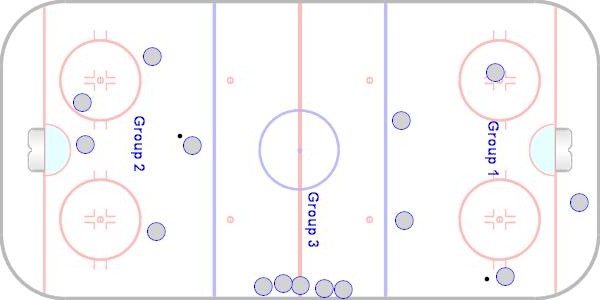
Description:
– Line A at one end practice attack options.
– Line B at other end practice attack options. Both walk through pp 5-0.
– Line C in middle passing practice.
– On whistle line A dump the puck to the other end and breakout returning to the original end while group C replace group B at the far end and group B pass in the neutral zone.
– Repeat with group C breaking out and back and group B switch with group A who move to the middle.https://www.hockeycoachingabcs.com/videos/watch/t2-kingston-power-play-and-team-play-rotation/

Attachments
'The Game is the Greatest Coach'
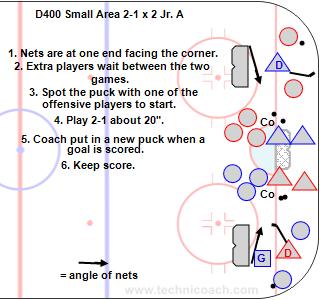
'Enjoy the Game'October 23, 2012 at 2:45 pm #6666KeymasterD400 – Small Area 2-1 x 2 – Jr. A
Key Points:
Defender eliminate the puck carrier crossing the midline of the net and the cross pass. Goalie and defender work together to make it a 2-2. Attackers use quick passes, quick shots, fake shots, one timers. Get the goalie moving and shoot where he came from and not where he is going.Description:
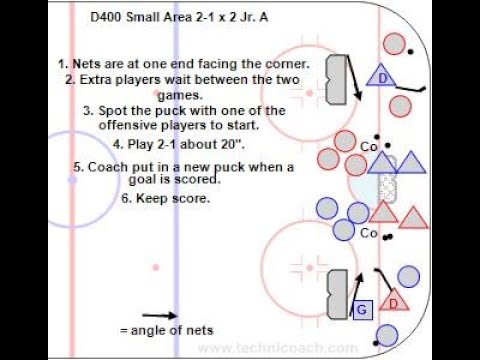
1. Nets are at one end facing the corner.
2. Extra players wait between the two games.
3. Spot the puck with one of the offensive players to start.
4. Play 2-1 about 20".
5. Coach put in a new puck on each net.
6. Keep score.https://www.hockeycoachingabcs.com/videos/watch/d400-small-area-2-1-x-2-jr-a/
Attachments
'The Game is the Greatest Coach'
'Enjoy the Game'October 24, 2012 at 3:11 pm #6668KeymasterB6 3-0 – One Touch Regroup – 3 Shots and High Cycle – Pro
Key Points:
Face the puck and one touch two passes to start. Shoot while skating and follow the shot for a rebound. This is done out of diagonal corners at the same time.Description:
1. F1 and F2 leave from the corner and exchange the puck twice with the D1.
2. F1 continue and get a pass from coach in the corner shoots and screens.
3. D1 pivot and Pass to F2 who shoots and screens.Option B:
4. Red F1 cycle out of the corner and pass to Blue D1 who passes to D2 and he passes to F1 high in the slot and F1 shoots.https://www.hockeycoachingabcs.com/videos/watch/b6-3-0-one-touch-regroup-3-shots-and-high-cycle/

https://www.facebook.com/518555930/videos/pcb.800540274189105/10159782794880931
Attachments
'The Game is the Greatest Coach'
'Enjoy the Game' -
AuthorPosts
- You must be logged in to reply to this topic.